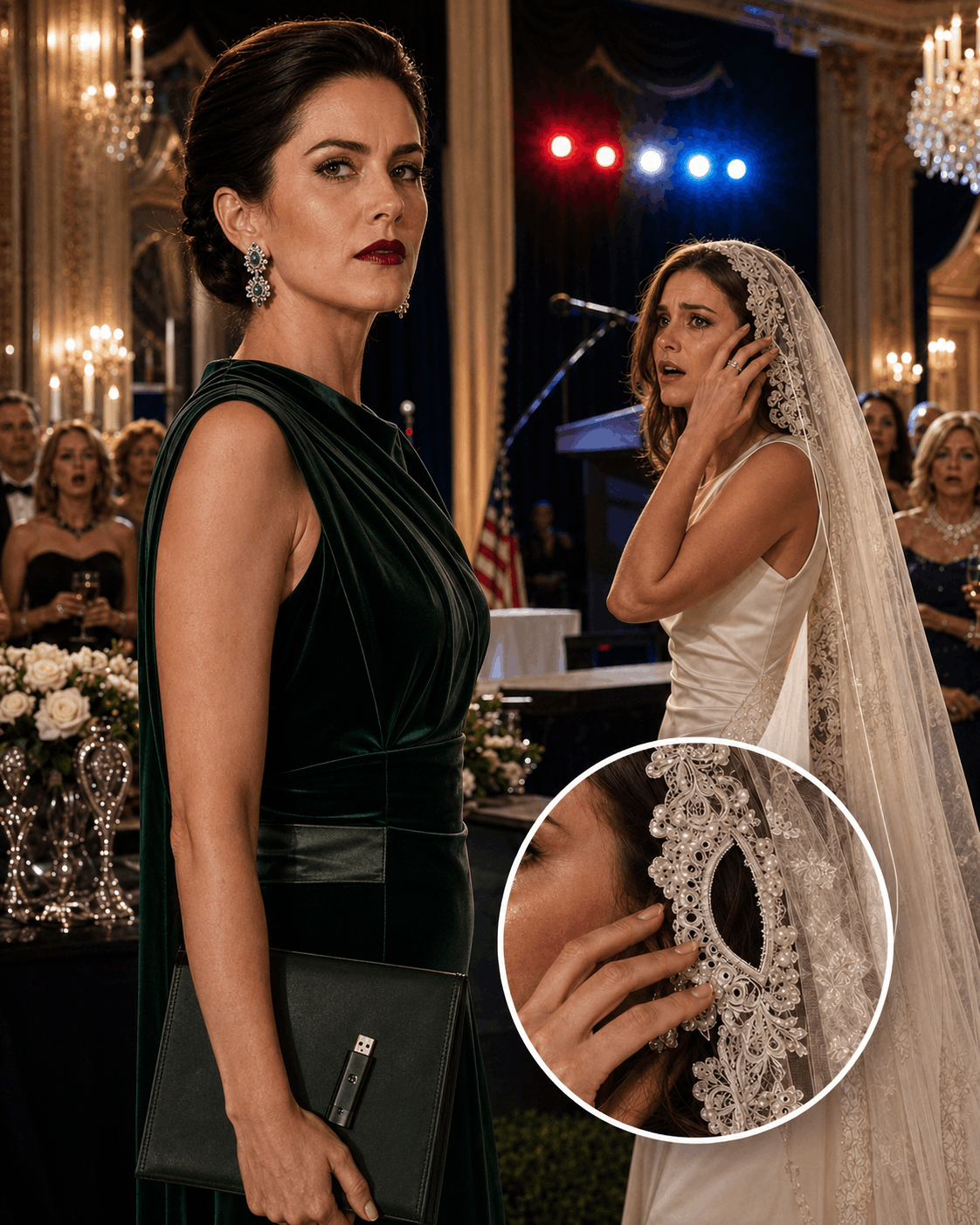
My husband’s mistress walked onto his victory stage wearing my wedding veil. Not a copy. Mine. He thought I would cry in the front row while the donors clapped and the cameras ate me alive, but what he did not know was that I had spent six months collecting every receipt, lease, wire transfer, and campaign record he thought I was too elegant to understand.
The ballroom at the Whitmore Grand Hotel looked like a rich man’s version of patriotism. Red, white, and blue lights rolled across crystal chandeliers, champagne towers, white roses, and smiling donors. My husband, Preston Whitaker, had just won his Senate race, and everyone in that room wanted to stand close enough to the new power to feel important.
I sat in the front row in a black velvet gown, calm enough to make people nervous.
Then Lila Monroe stepped onto the stage beside him. She was his campaign stylist, his public secret, and apparently the woman he believed could replace me before the victory speech was even finished. She wore a white satin gown and my mother’s wedding veil pinned into her hair like she had earned it. That veil had been kept in a cedar chest, wrapped in tissue and lavender, with my mother’s handwritten note still folded beside it.
Preston lifted Lila’s hand in front of the cameras. His wedding ring flashed under the lights while he smiled like a man who had already rewritten the story.
“I want to thank the woman who stood by me,” he said into the microphone.
The room started clapping before they remembered his wife was seated ten feet away. One by one, people turned toward me. Donors. Reporters. Staffers. Women who had whispered about me for months while pretending not to notice Lila adjusting my husband’s tie.
They expected tears, shaking hands, maybe a public scene that would let Preston call me unstable by breakfast.
I gave them nothing.
I took one sip of champagne and placed the glass down so softly the woman beside me stopped breathing. Preston’s eyes found mine, and for the first time all night, his smile slipped. Lila saw me too, and instead of looking ashamed, she touched my veil with two fingers.
That was her mistake.
She thought the veil was a crown. Preston thought my silence was surrender. His mother, Blythe, thought dignity meant I would protect the family name even while they buried mine.
For six months, I had done exactly what they expected. I hosted donor brunches, stood beside him at rallies, smiled for photographs, and let Lila wear dresses paid for by money she did not earn. I watched campaign funds move through consultants, shell companies, wardrobe invoices, and an apartment lease no campaign should have been paying. I watched Preston lie with the confidence of a man who had never met a document he could not bury.
But I did not marry him without learning how powerful men survive. They do not survive because they are innocent. They survive because women are trained to be embarrassed before they are angry.
So I stopped being embarrassed and started keeping folders.
In my clutch was a black flash drive. Beside it was a file with blue tabs, gold tabs, red tabs, and green tabs. The blue tabs were campaign funds, the gold tabs were donor shell companies, the red tabs were my stolen veil, and the green tabs were the apartment Preston told the world did not exist.
I rose while every camera in the room turned toward me. I walked past the donors, past his mother clutching her pearls, past the campaign manager who suddenly looked sick. I stopped in front of Mara Voss, the ethics reporter everyone in politics feared. She looked at the file in my hand and whispered, “Mrs. Whitaker?”
I placed it in her hands and said, “Use the blue tabs first.”
Mara Voss did not move for three full seconds.
She looked at the file. Then at the stage where Preston was still smiling into the cameras with Lila’s hand raised in his. Then back at me.
“How long have you had this?” she asked.
“Six months,” I said. “The blue tabs are indexed. Start with the November 3rd transfer.”
She opened the file. Her eyes moved across the first page and something shifted in her face. Not surprise exactly. The particular focus of a reporter who has just confirmed something she had suspected but could not yet prove.
“Mrs. Whitaker,” she said carefully, “if what’s in here is what I think it is—”
“It is,” I said. “The flash drive has the wire transfer records. The passwords are on the inside cover.”
She closed the file and held it flat against her chest.
On the stage, Preston finished his speech to a wave of applause. He turned to kiss Lila’s cheek and the cameras went bright with it. His mother Blythe was on her feet in the third row, one hand pressed to her heart like she was watching something sacred.
My phone buzzed. Preston. I turned it face down.
Mara said, “I need to ask you something off the record.”
“Ask.”
“The apartment in the green tabs.” She kept her voice low. “Is there documentation of who signed the lease?”
“Page forty-one,” I said. “Initialed by Preston and countersigned by the campaign treasurer.”
Her jaw tightened. “The treasurer signed a personal lease with campaign funds?”
“He signed four documents he likely assumed would never surface,” I said. “The lease was the smallest one.”
Mara looked toward the stage again. Preston had stepped down and was working the room, shaking hands, accepting congratulations, moving through the ballroom like a man who owned every inch of it.
He had not noticed me yet.
Then his campaign manager, Derek Holt, appeared at my left shoulder. His face was the color of old paper.
“Mrs. Whitaker,” he said. “Whatever you just gave her—”
“Is documented, verified, and copied,” I said. “Three copies. Three separate locations.”
Derek looked at Mara. Then back at me. “Preston is going to want to speak with you.”
“I’m sure he will,” I said.
Across the room, Preston finally turned. He saw Derek first. Then Mara. Then the file in her hands.
His smile did not disappear all at once. It left the way expensive things leave — slowly, and with the specific look of something that understood its own value right up until the moment it didn’t.
He took one step toward me.
That was when Mara’s phone rang. She looked at the screen and said, “It’s my editor.”
She answered it before Preston could cross the room.
And the look on his face when he understood what that phone call meant was something I had waited six months to see.
Preston crossed the ballroom like a man who still believed the room belonged to him.
He moved through the congratulating hands and the champagne glasses and the red and white and blue lights with that particular walk of his, the one I had watched for eleven years, the one that said the space around him existed to frame him rather than contain him. Donors stepped aside. Staffers smiled and looked away. The room parted for him the way rooms had always parted for Preston Whitaker because that was what rooms had always done.
He stopped in front of me.
Mara was three feet to my left with her phone at her ear and the file held flat against her chest and her editor’s voice audible enough that I could hear the word “when” repeated twice in quick succession.
“Diane,” Preston said. He had not called me by my name in eight months. He used it now the way people use a tool they have not needed in a while, carefully, checking first to see if it still worked.
“Preston,” I said.
“Whatever you think you’re doing—”
“Mara,” I said, without looking away from him, “this is my husband. Senator-elect Preston Whitaker. Would you like a comment from him for the record?”
Preston’s jaw tightened.
Mara lowered her phone six inches. “Senator-elect Whitaker,” she said, “I’m looking at documentation of what appears to be the use of campaign funds for a private residential lease at 440 Carlisle Street. Do you have a response?”
The ballroom noise continued around us. The string quartet was playing something bright and celebratory near the champagne tower. Someone laughed loudly near the donor tables. The world had not stopped yet. It was still mid-stop, suspended in the half-second between the thing happening and the room understanding that it had happened.
“That file was obtained illegally,” Preston said.
“It was compiled from documents in my possession,” I said. “Wire transfer records from accounts I am a joint signatory on. Lease documents sent to our home address. Invoices billed to our household account.” I looked at him calmly. “Everything in that file came to me legally, Preston. You sent most of it yourself.”
His eyes moved to Mara.
“I’d strongly advise you not to publish anything without speaking to my attorney,” he said.
“I’d strongly advise you to get your attorney on the phone,” Mara said. She said it pleasantly, the way people say things when they know exactly where they stand. Then she lifted her phone back to her ear and walked toward the corridor.
Preston watched her go.
Then he turned back to me and the pleasant public face was gone and underneath it was something I had not seen often but recognized immediately. The specific expression of a man who has just understood that the situation is not what he thought it was and is trying very quickly to calculate what it actually is.
“How long?” he asked.
“Six months,” I said. “Since the night you told me the Carlisle Street charges were a campaign housing expense and I looked up the address and found a two-bedroom apartment with a twelve-month lease and Lila Monroe’s name on the utilities.”
He was quiet.
“I gave you opportunities to tell me the truth,” I said. “In February, when I asked about the consultant invoices. In April, when I asked about the donor shell accounts. In June, when I found the cedar chest open and my mother’s veil missing.” I looked at him steadily. “You told me I was imagining things. You told me I was stressed from the campaign. You told me I needed to trust you.”
“Diane—”
“You put my mother’s veil on another woman and walked her onto a stage in front of cameras,” I said. “There is no version of that sentence that ends with me protecting you.”
He pressed his hand flat against his jacket, the gesture he made in debates when he needed a second to regroup.
“The file,” he said. “What exactly did you give her?”
“Everything,” I said. “Blue tabs are the campaign fund transfers. Eleven transactions over eight months, routed through three consultant LLCs that share a registered agent in Delaware. Gold tabs are the donor shell companies, two of which made contributions that exceed the legal limit when you trace them back to their parent entities.” I paused. “Red tabs are the documentation on the veil. The cedar chest has a biometric lock, Preston. It logs every access. You opened it on September 14th at 11:42 p.m.”
His face did not move.
“Green tabs are the Carlisle Street lease,” I said. “Signed by you, countersigned by Derek, paid from the campaign operating account across seven monthly transfers disguised as advance staff housing.” I looked at him. “That last part is the one the DA’s office will find most interesting.”
“You went to the DA,” he said. It was not a question.
“My attorney did,” I said. “Three weeks ago. Tonight was not the beginning of this, Preston. Tonight is the part where you find out it already happened.”
Lila appeared at his shoulder.
She had come down from the stage and crossed the ballroom and arrived at his side the way she had been arriving at his side for the better part of two years, smoothly and with the confidence of a woman who had decided she had already won.
My mother’s veil was still in her hair.
She looked at me and then at Preston and read something in his face that made her own face change.
“What’s happening?” she asked.
“Go back to the stage,” Preston said.
“Preston—”
“Lila.” His voice dropped. “Go back to the stage and smile and do not speak to anyone from the press. Do you understand me?”
She looked at me. “What did you do?”
“I kept records,” I said.
Her hand went to the veil. Not to remove it. To hold it. The same gesture Sloane had made with my grandmother’s lace, the reach for the taken thing when you suddenly understand it may need to be returned.
“That veil belonged to my mother,” I said. “She wore it the day she married my father. She kept it for thirty-one years and wrote a note to put beside it because she wanted me to have something of hers on the most important day of my life.” I looked at Lila steadily. “Take it off.”
Lila looked at Preston.
He said nothing.
She reached up and removed the pins one by one. Her hands were not steady. The veil came loose and she held it out to me and I took it and folded it over my arm and felt the weight of it, the specific lightness of old silk that has been kept carefully by someone who understood its value.
“Thank you,” I said.
Lila said nothing. She turned and walked back toward the stage and did not look at Preston once on the way.
He watched her go.
“She didn’t know about the file,” he said.
“I know,” I said.
“She’s not—” He stopped. “This isn’t what she intended.”
“What she intended,” I said, “was to wear my mother’s veil onto a victory stage while I sat in the front row and understood my place. Whether she knew about the campaign finance piece is a separate question.” I looked at him. “But she knew what the veil meant. You both did. That’s why you chose it.”
He had no answer for that.
Derek Holt found us seven minutes later.
He came from the direction of the corridor where Mara had gone and his face had completed its journey from old paper to something closer to ash.
“She’s already called the national desk,” he said to Preston. “They’re pulling the story together tonight. She wants a comment by eleven.”
Preston looked at his watch.
“It’s ten forty-three,” Derek said. “Her editor has already seen the file. They’re going to run with the blue tabs and the Carlisle Street lease as the primary. The shell company piece will follow in a second story.”
“Call Richard,” Preston said. Richard Ames was his attorney. The one who had drafted the prenuptial agreement and the campaign compliance filings and the consultant LLC structures that were now sitting in blue and gold tabs in Mara Voss’s file.
“I already did,” Derek said. “He said—” He stopped. He looked at me. “He said he needs to know how complete the documentation is before he can advise a response.”
“Tell him complete,” I said.
Derek looked at Preston.
Preston nodded once.
Derek walked away without looking back.
Blythe Whitaker appeared from the third row.
She moved through the ballroom in her winter white gown with the specific purposefulness of a woman who has spent decades managing situations that threatened to become visible. She had handled Preston’s first drunk driving incident at twenty-two and his plagiarism accusation at twenty-six and the staffing complaint at thirty-one. She had handled all of it quietly and expensively and without leaving a record.
She stopped beside her son and looked at me and said, “Diane. Whatever is happening, we can resolve this privately.”
“It’s already public, Blythe,” I said.
“Nothing is public until it’s printed,” she said.
“Mara Voss’s editor has the file,” I said. “It goes to print tonight.”
Blythe looked at Preston. “What did you let her take?”
“He didn’t let me take anything,” I said. “He sent it to the house. He sent the invoices and the transfer confirmations and the lease renewal to our home address because he was managing the campaign paperwork from the library and he did not think I read the mail carefully enough to understand what I was looking at.” I folded the veil more precisely over my arm. “He was wrong about that.”
Blythe’s jaw set.
“The family name,” she said. “Eleven years of work. Preston’s career. Do you understand what you are doing to all of it?”
“I understand what was done to mine,” I said.
She looked at me for a long moment. The chandeliers threw light across her face and she looked very old suddenly in a way she had never looked before, not old in years but old in the specific way of someone who has just seen the thing they spent a lifetime building begin to come apart.
“You could have come to me,” she said.
“I came to you in March,” I said. “I told you about the Carlisle Street charges. You told me to be careful about making accusations I couldn’t support.” I looked at her. “So I spent three more months making sure I could support them.”
She said nothing.
“The veil, Blythe.” I held it toward her so she could see it clearly, the old silk, the careful handwork, the thing my mother had kept for thirty-one years. “You were at my wedding. You watched me wear this. You knew what it meant and you said nothing when it went missing.”
“I didn’t know—”
“You knew,” I said. Not loudly. Not with anger. Just the flat truth of it, stated plainly in a ballroom full of people who were beginning to understand that the victory party had become something else. “You knew and you decided it was acceptable collateral.” I lowered the veil. “That was your mistake, Blythe. Not Preston’s. Yours.”
She looked away first.
Richard Ames called Preston at eleven-oh-four.
I was in the corridor by then, sitting on a chair near the coat check with the veil across my lap and my attorney, Vivian Chen, on the phone from her home office where she had been waiting since nine-thirty.
“Mara’s story posted online twelve minutes ago,” Vivian said. “Blue tabs and Carlisle Street as the lead. The headline is—” She paused. “Do you want to hear it?”
“Yes,” I said.
She read it to me.
I sat with it for a moment.
“The campaign treasurer,” I said. “Derek.”
“His attorney called our office at ten fifty-eight,” Vivian said. “He’s prepared to cooperate with the ethics investigation in exchange for consideration. He says Preston directed the Carlisle Street transfers personally and that Derek flagged the compliance risk twice in writing.”
“Do we have the written flags?”
“We will by morning,” Vivian said. “Derek kept copies.”
Of course he did. People who follow instructions they know are wrong always keep copies. It is the only insurance policy available to someone who has already made their choice.
“The DA’s office?” I said.
“They’ve been watching the story since it posted,” Vivian said. “Our referral gave them a three-week head start. They’ll move quickly now that it’s public.” A pause. “Diane. You should know that Richard Ames has already contacted the Senate ethics committee on Preston’s behalf. He’s going to try to frame this as a bookkeeping error.”
“Let him try,” I said.
“The documentation is too specific for that narrative to hold,” Vivian said. “Eleven transactions, three LLCs, one lease, and a campaign treasurer willing to testify. That’s not a bookkeeping error. That’s a pattern.”
“I know,” I said.
“How are you?”
I looked at the veil in my lap. Under the corridor lights it looked exactly as it had always looked, the same silk, the same careful work, the same thing it had always been regardless of where it had spent the last three months.
“I’m all right,” I said.
“Preston is going to want a settlement conversation,” Vivian said. “His attorney will reach out tomorrow. He’ll want to frame the divorce terms around limiting further disclosure.”
“There’s nothing further to disclose,” I said. “Everything relevant is already in Mara’s file or with the DA’s office.”
“He won’t know that until his attorney tells him,” Vivian said. “Which means he’ll negotiate from fear, which is actually better for our terms.”
“Thursday,” I said. “Tell Richard we’ll discuss settlement terms Thursday. Not before.”
“Thursday,” Vivian agreed. “Get some sleep.”
I put the phone in my clutch beside the empty space where the flash drive had been.
Preston’s resignation from the Senate seat came eleven days later.
His attorney issued a statement citing the need to address personal and legal matters. The ethics committee investigation had been formally opened four days prior. The DA’s office had issued a target letter two days after that.
I read the resignation statement in my kitchen on a Tuesday morning with coffee going cold beside me.
It was four paragraphs. It mentioned his gratitude to the voters of the state and his commitment to his family and his intention to cooperate fully with all relevant inquiries. It did not mention Lila Monroe or 440 Carlisle Street or eleven campaign fund transfers or my mother’s wedding veil.
I folded the newspaper and put it in the recycling.
The veil went to a textile conservator on the upper west side that same week. She was a small, precise woman who examined it under a magnifying lamp for a long time before she spoke.
“It’s in good condition,” she said. “Better than I expected given the handling.”
“Can it be restored?”
“There’s nothing to restore,” she said. “It wasn’t damaged. It was worn by someone who didn’t take care of it the way you would have, but the silk is intact.” She set it down gently. “I can clean and re-press it. It will look exactly as it should.”
“Please,” I said.
She looked at me over the magnifying lamp. “Is it for someone?”
I thought about my mother’s handwritten note, still folded in the cedar chest. The note she had written for me on the occasion of storing it. The note that said she hoped I would find the right moment for it and that the right moment would be worth the waiting.
“Not yet,” I said. “But I’d like it ready.”
She nodded like that was a reasonable answer and wrote something in her ledger.
Vivian called on a Thursday morning three weeks after the resignation.
“Richard Ames just accepted the final terms,” she said.
I was standing at the window in the third-floor office I had taken back as my own after Preston moved to the Carlisle Street apartment. Outside, the city was doing what it did, continuous and indifferent and bright.
“All of them?” I said.
“Every point,” Vivian said. “Full asset disclosure and equitable division. His removal from all joint accounts and business interests effective immediately. A formal acknowledgment of the campaign finance misconduct signed by Preston and held by my firm. And the ethics committee cooperation clause we asked for.” A pause. “He fought hardest on the acknowledgment.”
“I know,” I said. “That’s why I asked for it.”
“It’s signed,” Vivian said. “Notarized this morning.”
I looked out at the city.
“Is it done?” I said.
“It’s done,” Vivian said. “Diane. It’s done.”
I stood at the window for a while after she hung up. The light was coming in at the angle it came in at this time of morning, the sharp-edged autumn light that made everything look more permanent than it was.
Eleven years. The donor brunches and the rallies and the photographs and the careful smiling and the six months of keeping folders while the campaign moved around me like weather I had learned to read before it arrived.
It was done.
I picked up my coffee and drank it while it was still warm.
That evening I took my mother’s note from the cedar chest and read it again.
It was three sentences in her handwriting, the careful looping script she used for important things.
I wore this the day everything changed for the better. I hope you find a day that does the same. Keep it until you’re sure.
I folded it back along its original creases and placed it beside the veil, which had come back from the conservator that morning wrapped in fresh tissue and smelling of nothing at all, which was exactly how preserved things should smell.
I closed the cedar chest.
Outside the window the city was lit and continuous and I was thirty-nine years old and the house was quiet in the way that houses are quiet when they belong entirely to the person standing in them.
I did not feel like a woman who had survived something.
I felt like a woman who had done the work and was still standing, which is a different thing entirely, and in my experience the better thing to be.
I turned off the lamp.
The chest sat in the corner of the room in the dark, holding what it had always held, waiting for the right moment the way my mother had said to wait.
I trusted her on that.
She had always been right about the things worth keeping.
Some things are worth protecting quietly, for a long time, until the moment arrives when protecting them means something. Has someone ever underestimated what you were willing to do for what belonged to you? Tell me in the comments — I’d love to hear your story.