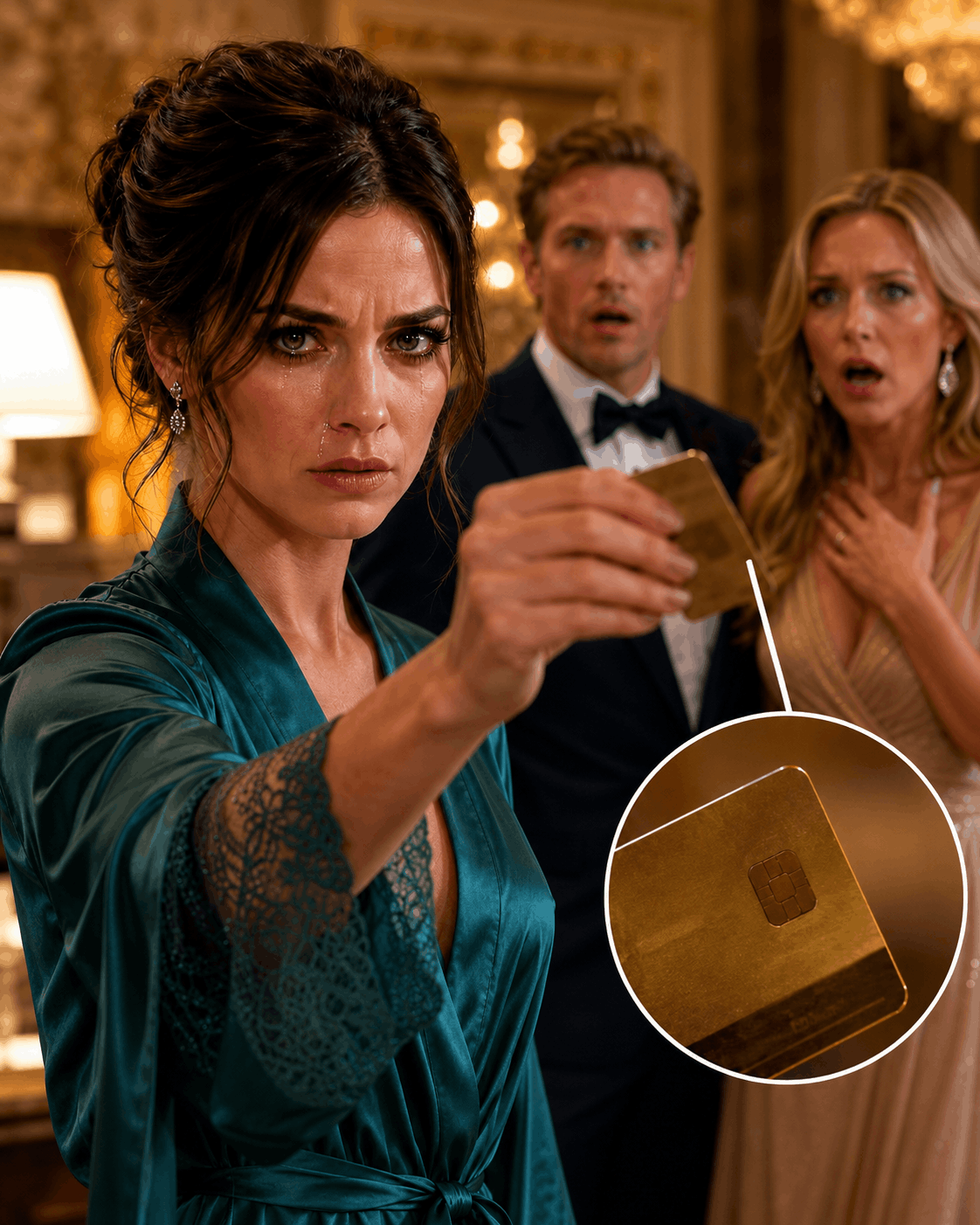
His mistress mailed me their honeymoon itinerary with my credit card attached, then wrote, “Hope you enjoy knowing where he chose me.” She thought I would scream, cry, and embarrass myself while they flew first class to paradise. What she did not understand was that the last four digits on that booking were tied to my private business account. By the time they reached the airport, I was not broken. I was already holding evidence.
The envelope arrived at my townhouse on East 73rd Street in Manhattan like an insult dressed for a gala. Ivory paper, gold seal, perfect handwriting, and a travel packet thick enough to make the cruelty feel expensive. Inside were first-class flights to Bora Bora, a private villa, champagne, massages, and a romantic package my husband had never once planned for me.
His name was on the reservation beside hers. Her name was Sloane Avery. She was younger, polished, and very sure the world would forgive her because she looked delicate while hurting people.
My husband, Bennett Whitmore, came from the kind of family that believed scandal was only scandal if poorer people found out. They had old portraits, old money, and old excuses. I had spent ten years making his life look stronger than it really was.
I did not call him. I did not call her. I did not post a crying video or throw his clothes onto the sidewalk so strangers could clap for my pain. I sat at my breakfast table, read the booking confirmation, and looked at the card ending in 3918.
Then I recognized the account.
That card was not Bennett’s. It was connected to Vale House Group, my private business account, the one he used to call my “little side project.” That little side project owned hotels, property, and quiet leverage he had never bothered to understand. Men like Bennett do not fear what they think belongs in the background.
That was his first mistake.
I called my CFO and froze the card. I called the travel company and canceled the reservation. I filed the fraud claim before they even finished their champagne at JFK. Then I called my attorney, Mara Ellis, and told her exactly what had arrived in the mail. Her only instruction was, “Do not confront him.”
That evening, Bennett called again and again. His texts went from confused to angry in less than ten minutes. “Clara. Did you cancel something?” Then, “Call me now.” Then the one that almost made me laugh: “This is embarrassing.”
He came home after midnight still wearing his travel blazer, furious because paradise had closed its doors. He stepped into the library and asked what the hell I had done. I looked at him calmly and told him I had canceled an unauthorized charge to my company. He said it was a mistake. I asked him if a twelve-day, seventy-eight-thousand-dollar honeymoon with his mistress counted as a mistake.
His face changed, but only for a second. Then he did what weak men do when receipts enter the room. He tried to negotiate instead of apologize. He told me not to make things uglier than they needed to be. He said we could handle everything privately, like adults. He said I had humiliated him.
That was when I looked at the man I had protected for ten years and realized he still thought I was afraid of losing his name.
The next morning, a note sat on the breakfast table in his handwriting. It said, “We need to manage the narrative.”
I placed it in an evidence sleeve.
Because Bennett still believed this was about reputation, but my attorney had already found the one clause his mother had written to protect the Whitmore family from me. And now that clause was pointing at him.
—
Mara arrived at the townhouse at seven the next morning with two coffees and a document she had tabbed in four places.
She set it on the breakfast table beside Bennett’s note, still in its evidence sleeve, and said, “Have you read the Whitmore family trust agreement?”
“He never showed it to me,” I said.
“He wouldn’t have.” She opened to the first tab. “His mother drafted this in 2009, two years before you married. It was written to protect Whitmore family assets from any spouse Bennett might acquire.” She paused. “The language is very precise. It defines protected assets as anything originating from Whitmore family capital.”
“Which excludes Vale House,” I said.
“Entirely. Vale House Group was built on your capital, your credit, your contacts. Bennett contributed nothing to it financially.” Mara turned to the second tab. “But here is where it gets interesting. The clause his mother wrote to protect the family from you also defines the threshold for what constitutes marital misconduct.”
I looked at the page.
“His mother wrote the definition herself,” Mara said. “Unauthorized use of a spouse’s private financial accounts. Misrepresentation of assets during the marriage. Introduction of a third party into the marital household finances.” She looked at me. “Sloane Avery’s name is on a supplementary card tied to Bennett’s personal account. An account that received three transfers from the Whitmore trust during the marriage.”
I set down my coffee.
“His mother’s clause,” I said slowly, “triggers against him.”
“In four separate places,” Mara said. “If we file under the trust’s own misconduct provision, the protected assets don’t transfer to him in the divorce. They revert.” She turned to the third tab. “There’s more. The fraud claim you filed yesterday on the Vale House card flagged two prior transactions. Same card. Same billing pattern. This wasn’t the first time, Clara.”
The room was very quiet.
“How many times?” I asked.
Mara looked at me steadily. “Seven. Over fourteen months.”
I looked at Bennett’s note in its evidence sleeve. We need to manage the narrative.
“He’s been planning this longer than I thought,” I said.
“Yes,” Mara said. “But so have we.” She turned to the fourth tab. “There’s one more thing. The supplementary card on Bennett’s account — the one Sloane has been using — was applied for using a Vale House Group address.”
My address. My company’s address.
“That’s identity fraud,” I said.
“That,” Mara said, closing the folder, “is exactly what I told the DA’s office this morning.”
My phone buzzed on the table. Bennett. I turned it face down.
Then the front door opened with a key that should no longer have worked, and Bennett Whitmore walked into his own narrative too late to change it.
Bennett saw Mara first.
He stopped in the doorway of the breakfast room with his coat still on and his keys in his hand and his face doing the calculation men like him always do when they walk into a room and find it already arranged against them.
“Clara,” he said. “I didn’t know you had company.”
“You didn’t knock,” I said.
“I have a key.”
“Had,” Mara said pleasantly. She did not look up from the folder.
Bennett looked at me. “I came to talk. Privately.”
“Anything you’d like to say to me you can say in front of my attorney,” I said. “Sit down, Bennett.”
He did not sit. He set his keys on the sideboard the way he always did, the small habit of a man who needed to feel at home in a room even when the room had stopped being his. Then he looked at the folder on the table and at Bennett’s note in its evidence sleeve and at the two coffee cups and at my face.
“How long has she been here?” he asked.
“Long enough,” Mara said.
He pulled out the chair across from me and sat down. He had not taken off his coat. I noticed that. Bennett always took off his coat. Keeping it on meant he had not decided yet whether he was staying.
“I want to explain about the card,” he said.
“Which time?” I asked.
His eyes moved to mine. “What?”
“The card was used seven times over fourteen months,” I said. “I’m asking which time you’d like to explain.”
The coat stayed on. But his shoulders dropped a quarter inch and I had known this man for twelve years and I knew what that meant. He had come here believing I knew about Bora Bora. He had not known I knew about the rest.
“Clara—”
“The first transaction was in October of last year,” I said. “Eleven thousand dollars to a residential interior design firm. I looked it up this morning. They specialize in high-rise apartments on the Upper West Side.” I folded my hands on the table. “Is that where she lives, Bennett? Did you decorate her apartment with my company card?”
He said nothing.
“The third transaction was to a jeweler on 57th Street,” I said. “Four thousand, six hundred dollars. I don’t own anything new from that jeweler. Do you want to tell me what was purchased or should I call them myself?”
“You don’t need to call anyone,” he said.
“Then tell me.”
He looked at Mara. “Is this conversation being recorded?”
“Do you have a reason to be concerned about that?” Mara asked.
He looked back at me. Something in his face had shifted from the negotiating expression he had worn the night before into something older and less rehearsed. I had seen this face before. Not often. Bennett was careful about what he let show. But I had seen it once when his father’s health had deteriorated suddenly and he had not known how to be afraid in front of anyone, and the expression had slipped for just a moment before he put it away.
He was afraid now.
“I made mistakes,” he said.
“Yes,” I said.
“I’m not going to pretend otherwise.” He leaned forward. “But Clara, if this goes the way you’re setting it up to go, it hurts both of us. The Whitmore name is tied to Vale House whether you want it to be or not. If the fraud claim becomes public—”
“The fraud claim is already with the DA’s office,” Mara said.
The color left his face.
“As of this morning,” she continued. “Along with documentation of all seven transactions and the application for the supplementary card using a Vale House Group address.” She paused. “That last piece is identity fraud, Bennett. That’s not a civil matter.”
He stood up. The chair scraped back hard.
“That application was a clerical error,” he said. “Sloane filled out the form and she used the wrong address—”
“Sloane Avery filled out a credit application using your wife’s company address,” Mara said. “In your name. With your signature.” She opened the folder to the third tab. “Is this your signature?”
He looked at the page. His jaw tightened.
“Is that your signature, Bennett?” Mara asked again.
“You know it is,” he said.
“Then it wasn’t a clerical error,” she said. “Sit down.”
He sat.
The room was quiet for a long moment. Outside on East 73rd Street a car passed and then another and the city continued its indifferent morning without any interest in what was happening at my breakfast table.
“What do you want?” Bennett asked finally. He was looking at me, not Mara. That was the first honest thing he had done since he walked through the door.
“I want to know one thing first,” I said.
He waited.
“The note this morning,” I said. “We need to manage the narrative. Whose narrative were you managing? Mine or yours?”
He was quiet for too long.
“Yours,” he said. “I thought if we handled it quietly—”
“You thought if we handled it quietly you would walk away with the Whitmore assets intact and a clean reputation and Sloane Avery on your arm by spring,” I said. “You weren’t managing my narrative. You were managing your exit.”
He did not deny it.
“The clause,” I said. “Did you know about it?”
His eyes moved to the folder.
“Your mother wrote it to protect the family from me,” I said. “Did you know it would trigger against you?”
“She didn’t write it to trigger against me,” he said. “She wrote it for—”
“For exactly this situation,” Mara said. “Unauthorized use of a spouse’s private financial accounts. Misrepresentation of assets. Introduction of a third party into marital finances. Your mother was very thorough, Bennett. She simply didn’t anticipate that the spouse most likely to commit those acts was you.”
Something crossed his face that I did not have a word for. Not shame exactly. Closer to the specific humiliation of a man who has just understood that the trap his family built to catch his wife has closed around his ankle instead.
“What does the clause mean for the settlement?” he asked.
“It means the Whitmore protected assets don’t transfer to you in the divorce,” Mara said. “They revert under the trust’s own misconduct provision. It means Vale House Group remains entirely Clara’s, which it always was. It means the three trust transfers to your personal account during the marriage are now considered misconduct distributions and will be factored into the settlement.” She turned a page. “It means you leave this marriage with considerably less than you planned.”
Bennett sat with that for a moment.
Then he said something I had not expected. He said it quietly, almost to himself, looking at the table rather than at me.
“She’s pregnant,” he said.
The room went very still.
I looked at him. “Sloane?”
“Yes.”
I breathed once, carefully.
“That doesn’t change what happened,” I said.
“I know,” he said. “I’m not asking you to—I’m not asking for anything.” He pressed his hand flat on the table. “I just thought you should know. Before this goes further. Because it will come out and I didn’t want you to hear it in a deposition.”
I looked at this man I had spent twelve years beside. I had loved him, genuinely and without reservation, for most of those years. I had built a company he called a side project. I had made his life look stronger than it was. I had sat across from his mother at Sunday dinners for a decade while she catalogued my inadequacies in the careful language of a woman who had learned to wound without leaving marks.
And now he was sitting in my breakfast room in his coat telling me his mistress was pregnant and presenting it as a courtesy.
“Thank you for telling me,” I said.
He looked up.
“Mara will be in touch with your attorney this afternoon,” I said. “I’d like you to leave your key on the sideboard.”
He looked at me for a long moment. Then he reached into his coat pocket and placed the key beside his other keys on the sideboard.
He stood. He buttoned his coat. He was almost to the door when he stopped.
“I did love you,” he said. “In the beginning. I want you to know that.”
“I know,” I said. “That’s the part that took me longest to stop being angry about.”
He left.
The door closed.
Mara waited three seconds. Then she said, “Are you all right?”
“Ask me in ten minutes,” I said.
She nodded and turned back to the folder.
The ten minutes passed. Then another ten. Mara made more coffee and I sat at the table where an ivory envelope had arrived two mornings ago like an insult dressed for a gala and I thought about the last fourteen months with the specific clarity that comes when all the information finally arrives at once.
He had been planning the exit for over a year. The apartment, the jewelry, the card, the supplementary application. Bora Bora was not an impulsive romantic gesture. It was a closing ceremony. He had wanted me to see the itinerary. He had wanted me to see my card attached to it. He had given it to Sloane to send because he wanted her fingerprints on the cruelty, not his.
He had wanted me angry and loud and unstable.
He had not wanted me sitting at a breakfast table with my CFO on the phone and my attorney already tabbing a trust document in four places.
“The DA’s office will move on the identity fraud within the week,” Mara said. “The civil filing we can have ready by Thursday.”
“Thursday is fine,” I said.
“Bennett’s attorney will push for a private settlement.”
“I know.”
“Do you want one?”
I thought about it. I had never needed the public version of this. I had not canceled the Bora Bora reservation because I wanted witnesses. I had not filed the fraud claim because I wanted a headline. I had done those things because they were the correct and necessary steps in the correct and necessary order, and because my CFO had flagged the account and my attorney had answered her phone and the work had been done the way I had always done work, quietly and thoroughly and without waiting to be told.
“If he meets the terms,” I said, “private is fine.”
“What are the terms?”
I told her.
Full dissolution of any claim on Vale House Group or its subsidiaries. Return of the three trust distributions with interest. His signature removing himself from the supplementary insurance policies that still listed him as beneficiary on two of my company’s key-person policies. A written acknowledgment of the unauthorized card use, signed, notarized, and held by Mara’s firm. And the Whitmore family trust to proceed under its own misconduct clause without contest from his attorneys.
Mara wrote everything down.
“He’ll fight the last one,” she said.
“His mother wrote it,” I said. “Let her explain to her son why she wrote it the way she did.”
Mara almost smiled. “I’ll call his attorney at noon.”
She left at ten-thirty.
I stood at the window in the front room and looked at East 73rd Street for a while. The morning had cleared into one of those sharp-edged autumn days that Manhattan does better than anywhere, the light coming off the buildings at an angle that made everything look more permanent than it was.
My phone showed fourteen missed calls from Bennett over the past two days. Below those, a text from Sloane Avery sent the morning the envelope arrived. It said only: Hope you enjoy knowing where he chose me.
I had not answered it. I had not saved it to anything. I did not need it.
The fraud claim, the trust document, the DA referral, the fourteen months of transaction records — those were the answer. Everything else was just noise that had arrived in an ivory envelope with a gold seal.
I put the phone in my pocket and went to my office on the third floor.
Bennett’s attorney called Mara at 12:40 p.m.
By 3:15 p.m., he had agreed to the first four terms without significant resistance.
The fifth — the trust misconduct clause — took until the following Tuesday. Bennett’s mother called once during that period, on Sunday evening, and left a voicemail I did not listen to until Mara told me the clause had been confirmed. Then I listened to it once, standing in my kitchen.
She said she had always respected me. She said she hoped I understood that the trust had been written to protect the family and not as any personal statement about my character. She said she wished things had gone differently.
I deleted the message and made dinner.
The civil filing was complete by the end of the month.
The DA’s office issued a formal notice to Bennett and Sloane regarding the identity fraud application two weeks after that. Bennett’s attorney negotiated a resolution that included full restitution and a conditional agreement. Sloane’s attorney handled hers separately. I was not involved in either process beyond providing documentation when Mara requested it.
I did not follow what happened to Sloane after that. She had made her choices in the specific way people make choices when they are very sure the world will forgive them because they look delicate while hurting people. Whatever the world decided to do with that was not my concern.
Vale House Group closed its strongest quarter in six years in December.
My CFO sent me the numbers on a Thursday morning and I read them at my desk with coffee going cold beside me and the autumn light coming through the third-floor window at the angle that made everything look more permanent than it was.
I had built this. Not as a side project. Not as a background thing that a man with old portraits and old money had graciously permitted to exist beside his real life. I had built it the way my grandmother had taught me to build anything worth keeping — slowly, carefully, without making noise about it until the thing was strong enough to stand on its own.
It was standing.
I finished my coffee and opened the next file.
That evening I took the ivory envelope from the drawer where I had kept it and held it for a moment. The gold seal. The perfect handwriting. The expensive cruelty of it.
Then I put it through the shredder.
Not because I needed to forget it. I did not need to forget it. I needed it to be finished, which is a different thing entirely.
The shredder ran for three seconds and then it was done.
I turned off the office light and went downstairs.
The townhouse was quiet in the way it had not been quiet for a long time — not the held-breath quiet of a marriage going wrong in slow motion, but the particular quiet of a space that belongs entirely to the person standing in it.
I poured one glass of wine.
I did not pour a second.
I sat at the breakfast table where two mornings ago everything had clarified, and I thought about the woman who had sent that envelope expecting devastation and instead had handed me the one piece of evidence I needed to begin.
Hope you enjoy knowing where he chose me.
I had enjoyed knowing exactly that.
I raised the glass slightly, to no one in particular, and drank.
The most dangerous thing some people will ever underestimate is a quiet woman who has already done the work. Have you ever had someone mistake your silence for weakness — and lived to see the moment they understood their mistake? Tell me in the comments. I’d love to hear your story.