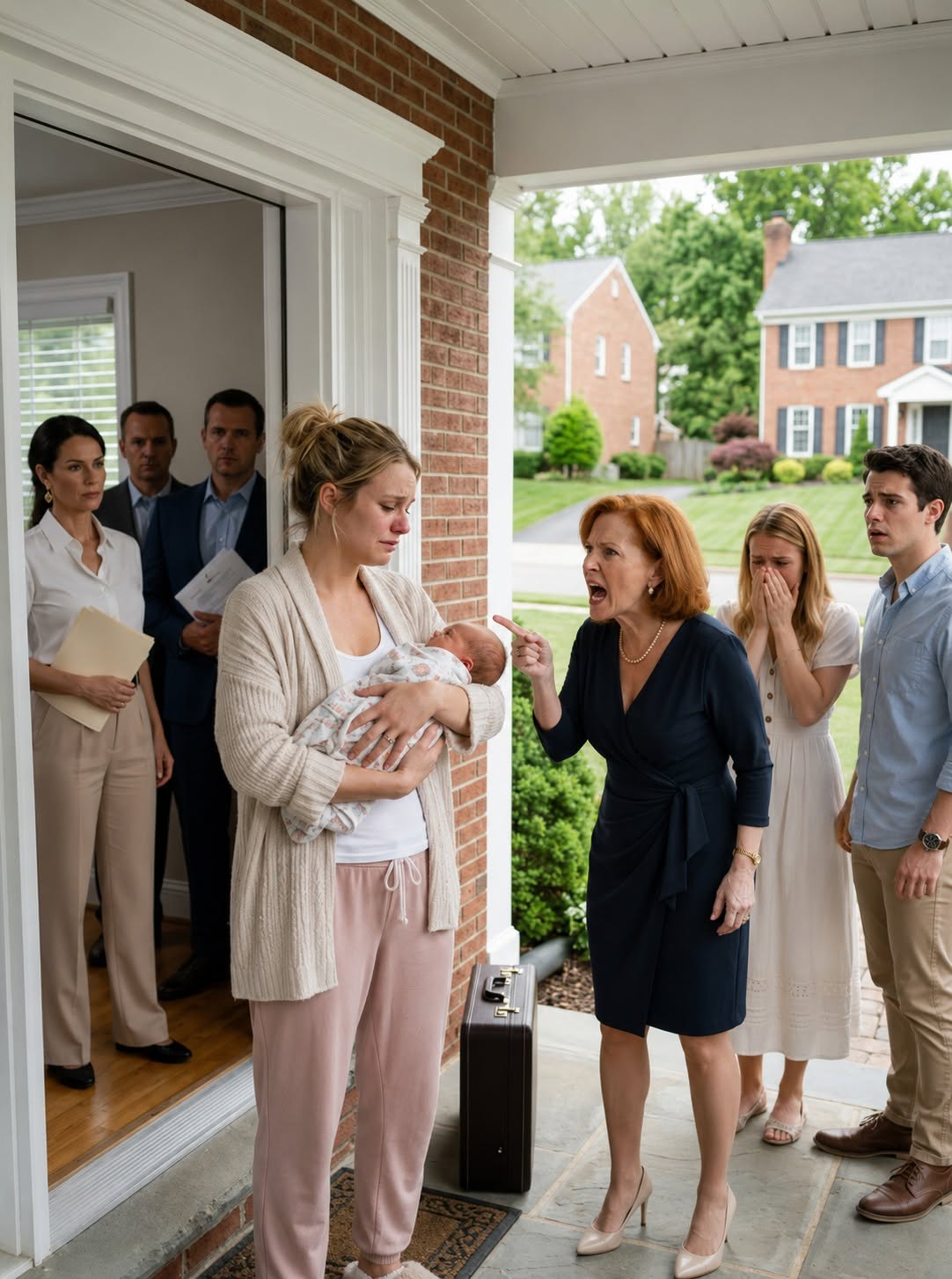
I bought a small blue house so my newborn daughter and I could finally be safe after my husband died, but my mother arrived with suitcases, relatives, and a stolen key, ready to push me into the living room and claim my home as family property — without knowing my brother-in-law was waiting behind the chained door with police, legal documents, and proof that this house belonged only to Emilia and me.
The very first evening that Lucía Reyes spent in the home she had bought for herself and her newborn daughter ended with an unexpected knock. Standing outside was her mother, carrying several suitcases and fully intending to take over the house — and force Lucía out.
Only three weeks had passed since Lucía had given birth by C-section. The incision still ached whenever she moved. One hand instinctively supported her healing abdomen while the other cradled little Emilia, whose gentle breathing against her chest was the only thing calming the storm inside her heart.
The little blue house sat quietly at the end of Bugambilias Street in Tlaquepaque, Jalisco. It wasn’t impressive by most standards. A white iron gate guarded the entrance, a skinny lemon tree grew in the modest backyard, and sunlight flooded the front room every morning.
There were no expensive finishes, crystal chandeliers, or sprawling gardens.
Yet to Lucía, it was worth more than any mansion.
It represented freedom.
Inside those walls, no one would scream at her across the kitchen. No one would rummage through her belongings without permission. No one would insist that whatever belonged to her automatically belonged to the rest of the family.
She had paid for the house using the insurance settlement left behind after her husband, Andrés, died.
Seven months into her pregnancy, Andrés had been driving toward Chapala when a truck lost its brakes during a heavy rainstorm. The collision killed him instantly.
At the Civil Hospital, someone quietly handed Lucía a small plastic bag containing his wedding ring, his soaked wallet, and the receipt for a package of diapers he had bought only hours before the accident.
That was the day she learned tears could fall without making a sound.
During Andrés’s funeral, relatives offered rehearsed condolences while patting her shoulder with sympathetic smiles.
Her mother, Doña Rosa, leaned close enough for only Lucía to hear.
“Now you’ll finally understand how much you need your family.”
Lucía understood exactly what those words really meant.
It meant her sister Maribel would constantly “borrow” money she never intended to repay.
It meant her brother-in-law Tomás would settle into her living room as though he owned the place.
It meant her nephews would treat the house like a playground while Lucía struggled to recover and care for a newborn.
Most of all, it meant Doña Rosa would once again control every part of her life — deciding when she should eat, what she should say, and how grateful she was expected to be.
That was why, when the paperwork for the house was completed, Lucía insisted that every document list only one owner: herself.
She also prepared another legal document declaring that one day the entire property would pass directly to Emilia.
No one else.
That evening, as the tamale vendor made his final rounds through the neighborhood and the tortilla shop rolled down its metal shutters, Lucía carefully attached two freshly printed names to the mailbox.
Lucía Reyes Emilia Reyes
She stood there for a long moment, staring at those names until tears blurred her vision.
“We finally made it, my precious girl,” she whispered. “Your daddy made sure we’d always have a home.”
Emilia slept peacefully, barely moving.
Around 10:30 that night, Lucía slowly eased herself into an old armchair a kind neighbor had donated.
Just as she closed her eyes, her phone rang.
Mom.
The single word on the screen immediately tightened her chest.
She answered only because years of habit were difficult to break.
“Hello?”
“Lucía,” Doña Rosa said without bothering to greet her. “Maribel is moving out of her apartment this Friday. Tomorrow morning we’re all coming to your house.”
For several seconds, Lucía couldn’t process what she’d just heard.
“What do you mean… you’re coming to my house?”
“What else would I mean?” her mother replied matter-of-factly. “Your place has two bedrooms. I’ll take one with the children. Maribel and Tomás can use the other. You and the baby can sleep in the living room. You’re young — you’ll be fine.”
The warmth drained from Lucía’s hands.
“No, Mom. I just had surgery. Emilia and I need rest. We need a quiet home.”
Doña Rosa laughed dismissively.
“Oh, stop being so dramatic. Families are supposed to help each other.”
“This house belongs to me.”
“Your house?” her mother snapped. “The only reason you even have that house is because Andrés died. Don’t start acting like you’re better than everyone else.”
Lucía glanced toward the framed photograph of Andrés resting on an unopened moving box. He was smiling in his faded denim shirt, proudly holding a bouquet of flowers he had bought at the San Juan de Dios Market — the same afternoon they learned they were expecting a daughter.
Taking a slow breath, Lucía answered quietly but firmly.
“You’re not moving into my home.”
Her mother’s voice turned icy.
“Don’t make me embarrass you. We’ll arrive first thing tomorrow morning. If you don’t like it, then you can leave. Emilia is my granddaughter too, and I have every right to be there.”
Before Lucía could respond, the call disconnected.
She remained frozen, staring at the dark phone screen, already knowing that tomorrow would change everything…
Doña Rosa’s car pulled up just after eight the next morning. Two more cars followed behind it — Maribel’s, packed with boxes, and Tomás’s, with the boys already hanging out the back window.
Lucía stood at the gate with Emilia asleep in her arms, her incision throbbing from a night she hadn’t really slept.
“Move your car,” she said. “You’re blocking the driveway.”
Her mother didn’t even look at her. She was already pulling suitcases from the trunk.
“Tomás, get the boxes from the back. Maribel, go check which bedroom gets better light.”
“Nobody is checking any bedrooms,” Lucía said. “I told you last night. You’re not staying here.”
Doña Rosa finally turned, suitcase in hand, her face arranged into practiced disappointment. “You’d really turn away your own sister? Your own mother? With nowhere else to go?”
“Maribel has an apartment.”
“Had,” Maribel snapped, brushing past Lucía through the gate like it wasn’t even there. “We got evicted. Where exactly do you expect us to sleep, on the street? With your niece and nephew?”
Lucía’s grip tightened around Emilia. “That’s not my emergency to fix.”
“It is when it’s family,” her mother said, already climbing the porch steps. “Now open the door before the neighbors start staring.”
That’s when the front door opened from the inside.
Not by Lucía’s hand.
Tomás — her brother-in-law, Andrés’s older brother — stood in the doorway, still in his work jacket, a folder tucked under one arm. Behind him, just visible through the gap, was a second man in uniform.
Doña Rosa froze on the top step.
“What is this,” she said slowly. “Whose house did you let him into?”
Tomás stepped fully onto the porch, and for the first time Doña Rosa’s suitcase lowered an inch.
“Tomás,” she said, forcing warmth into her voice. “I didn’t know you’d be here. Are you visiting Lucía too?”
“I live two streets over,” Tomás said. “Lucía called me last night. Right after you hung up on her.”
The officer behind him stepped forward, calm, unhurried. “Ma’am, is this your residence?”
“It’s my daughter’s house,” Doña Rosa said. “Which means it’s family property.”
“It’s her house,” Tomás said. “Just hers. Mine and Andrés’s father built her the case file himself before he died — Andrés wanted it that way in writing, in case anything ever happened to him.” He opened the folder and held it out, not to Doña Rosa, but to the officer. “Deed, insurance settlement records, and a notarized declaration naming Lucía as sole owner and Emilia as sole heir. Signed eleven months ago.”
“That’s not possible,” Maribel said, stepping up beside her mother. “Andrés would never cut out his own family.”
“He didn’t cut out family,” Tomás said quietly. “He made sure his daughter had one thing in this world nobody could take from her. I helped him file it. I’ve had a copy in my safe since before Emilia was even born.”
Doña Rosa’s face had gone rigid. “You knew about this. All this time, you knew, and you said nothing.”
“I said nothing because Lucía asked me not to,” Tomás said. “She didn’t want to fight you over paper. She wanted you to just… not come. But you didn’t leave her that choice.”
The officer looked between the suitcases stacked on the porch and the folder in Tomás’s hand. “Ma’am, this document is legally sufficient. If the homeowner is asking you to leave, you need to leave the property.”
“She’s my daughter,” Doña Rosa said, her voice cracking now, less certain. “I raised her. I have a right—”
“You have a right to visit if she invites you,” the officer said. “You don’t have a right to move in.”
Lucía hadn’t said a word through any of it. She stood at the gate, Emilia stirring faintly against her chest, watching her mother’s face cycle through disbelief, anger, and something that almost looked like shame.
“Mom,” she finally said. “I didn’t want it to happen like this. I called Tomás because I was scared you wouldn’t listen otherwise. I was right.”
“So this is what you’ve become,” Doña Rosa said. “Calling police on your own mother.”
“I called someone who would make sure you actually heard me,” Lucía said. “You’ve never once listened when I just asked.”
Maribel grabbed one of the suitcases, her face red. “Fine. We’ll figure something else out. We always do.” She looked at Lucía like she wanted to say something crueler, but the officer’s presence held her back. She turned and dragged the suitcase to the car instead.
Tomás waited until the cars had pulled out of the driveway before he let his shoulders drop. He looked at Lucía, then at Emilia, sleeping through all of it like the world outside her blanket hadn’t just rearranged itself.
“You okay?” he asked.
“No,” Lucía admitted. “But I will be.”
“Andrés would be proud of you,” he said. “He didn’t just want to protect you with that paperwork. He wanted you to know you were allowed to say no. To anyone.”
Lucía looked down at her daughter, at the two names still taped to the mailbox, catching the morning light.
“I know that now,” she said.
That afternoon, once the house was quiet again, Lucía sat in the donated armchair with Emilia against her chest and finally let herself cry — not from fear this time, but from something closer to relief. Tomás stopped by twice a week after that, sometimes with groceries, sometimes just to fix a loose hinge or check the lemon tree. He never asked for a key. He never needed one. Doña Rosa called once, a month later, her voice smaller than Lucía had ever heard it, asking if she could see Emilia sometime — not move in, just see her. Lucía said yes, on her terms, at her door, for as long as it stayed that way.
The little blue house on Bugambilias Street stayed exactly what it was always meant to be: quiet in the mornings, full of lemon-scented air, and entirely, legally, permanently hers.
Have you ever had to protect your home — or your peace — from the very people who were supposed to protect you? I’d love to hear how you found the strength to say no.