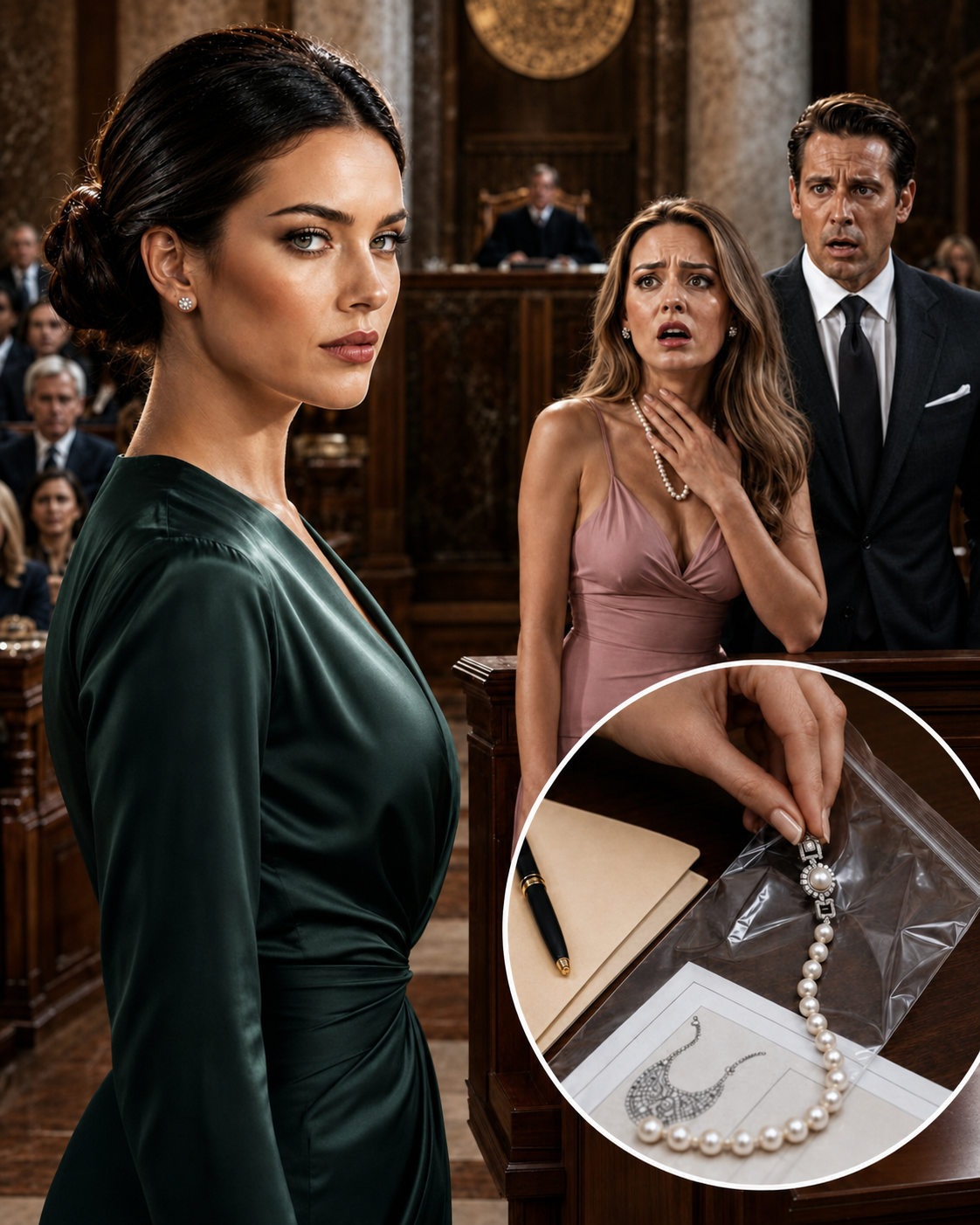
His mistress wore my de@d mother’s pearls to testify against me in court. My husband sat behind her, looking proud, like she was brave for lying under oath. They expected me to cry, shout, or prove I was unstable. What they did not know was that those pearls came with an appraisal, a police report, and a secret Grant had forgotten I could prove.
I sat at the defense table in a navy silk dress with my hands folded. My throat was bare on purpose. Across the room, Sloane Avery lifted her chin like she had earned those pearls. Grant watched my face, waiting for me to break.
I did not break. My mother had given me those pearls before she died and told me never to cry in a room where someone wanted to enjoy it.
So I looked at Sloane’s soft little courtroom outfit, her trembling voice, and the pearls resting against her neck. Then I glanced at my attorney, Vivian Hart, and she gave me the smallest nod.
Grant’s lawyer called Sloane to the witness stand. She swore to tell the truth with my mother’s pearls glowing under the courtroom lights. She said I was cold, jealous, unstable, and dangerous. She said I had threatened her outside a restaurant and made her fear for her safety. My husband lowered his head like her lies hurt him. His mother sat behind him in winter white, acting like this was all my shame. His father would not look at me.
Everyone in that courtroom seemed ready to believe the betrayed wife had finally lost her mind.
Sloane spoke softly, like every lie was a confession. She said I wanted to ruin her. She said I scared her. Then she touched the pearls and said Grant had given them to her because they belonged to his family.
That was the first mistake.
Grant’s jaw tightened, but he stayed silent. His lawyer should have stopped there, but pride makes people careless. He asked her one more question, and the whole room leaned in.
“Did you steal anything from Mrs. Caldwell?” he asked.
Sloane looked directly at me. “No,” she said. Then she smiled just enough for me to see it.
I remembered the night those pearls disappeared from my private safe. Nothing else was missing. Not my diamonds, not my emeralds, not the watch my father sent me out of guilt every birthday. Only my mother’s pearls.
Grant had opened that safe at 2:16 in the morning. The digital log recorded his thumbprint. The hallway camera showed him leaving my dressing room with a small black jewelry box. He looked straight into the camera and smiled. He wanted me to know. He wanted me angry. He wanted me loud enough to fit the story he had already told the court.
Unstable wife. Jealous wife. Dangerous mother.
That was why I filed the police report quietly. That was why I sent everything to Vivian quietly. That was why I walked into court with no necklace and no tears. They thought my silence meant I had nothing.
Vivian rose slowly when it was our turn. She carried one cream folder, not a stack of papers. Grant finally looked nervous. Sloane’s fingers curled around the pearls like they could protect her.
Vivian asked her about the restaurant first. Sloane said I threatened her outside Le Jardin on December 14 at about nine at night. Vivian nodded and placed a document on the table.
Le Jardin had been closed for renovations since November 28.
The courtroom went quiet. Sloane blinked. Grant’s mother stopped breathing like a woman trying not to make a scene.
Vivian turned the next page and said, “Now let’s talk about the necklace.”
The courtroom did not move.
Sloane’s hand was still curled around the pearls. Her knuckles had gone white.
Vivian opened the cream folder and placed a single photograph on the table. She did not rush. She did not explain. She simply turned it so the judge could see it clearly.
“Ms. Avery,” Vivian said, “do you recognize this image?”
Sloane leaned forward. Then she sat back. Something behind her eyes went very still.
“That’s a hallway,” she said carefully.
“It is,” Vivian agreed. “Specifically, it is the hallway outside Mrs. Caldwell’s private dressing room. Taken at 2:16 in the morning on November 9th.” She paused. “Do you see the man in the image?”
Grant’s attorney was on his feet. “Objection. Relevance.”
The judge looked at Vivian. “Counselor?”
“The witness testified that those pearls were a gift,” Vivian said. “I am establishing how they left Mrs. Caldwell’s possession.”
“Overruled. Continue.”
Sloane’s fingers loosened around the pearls. Just slightly. Just enough.
“Ms. Avery,” Vivian said. “Is that your husband in this photograph?”
“He’s not my husband,” Sloane said quickly.
“Is that Grant Caldwell?”
A pause. “Yes.”
“And what is he carrying?”
Sloane looked at Grant. He did not look back at her.
That was the moment. I watched it happen from the defense table. Six months of his promises and his careful stories and his version of everything, and he would not look at her when it mattered.
“A box,” Sloane said quietly.
“A small black jewelry box,” Vivian said. “Consistent in size and shape with the box in which Mrs. Caldwell stored her mother’s pearls.” Vivian reached into the folder. “I’d like to enter the digital security log as Exhibit F. The thumbprint recorded at 2:16 a.m. belongs to Grant Caldwell. The log was certified by the security company on November 12th.”
Grant’s mother shifted in her seat behind him. I heard the sound of it. A small scrape of a chair. The sound of someone realizing the room had changed.
Grant leaned to his attorney and said something low and fast.
His attorney stood. “Your Honor, we’d like to request a brief recess.”
The judge looked at him for a long moment. “We’ll finish the cross-examination first.”
Vivian turned back to Sloane.
“Ms. Avery,” she said. “I want to give you one more opportunity.” Her voice was not unkind. “Did Grant Caldwell give you those pearls as a gift?”
Sloane looked at Grant one more time. He was writing something on a notepad. He did not look up.
Her hand fell away from the pearls.
Then Vivian asked the question no one in that courtroom expected. And the answer Sloane gave changed everything.
…
Sloane looked at the pearls.
Not at Grant. Not at the judge. Not at Vivian or me or the packed rows of the courtroom. Just at the pearls, the way you look at something when you are trying to decide what it is worth to you now that everything has changed.
“He told me she had thrown them away,” Sloane said.
The courtroom was very still.
“I’m sorry?” Vivian said.
“Grant.” Sloane’s voice was flat now. The soft trembling was gone. “He told me Eleanor had thrown them away after her mother died. That she couldn’t stand to look at them. He said they were just sitting in a box in storage and that it would be a shame to waste them.” She paused. “He said if I wore them in court it would rattle her.”
Someone in the gallery made a sound. A small sharp intake of breath.
Grant’s attorney put his pen down.
I kept my hands folded on the table. My mother had told me never to cry in a room where someone wanted to enjoy it. She had not said anything about the rooms where no one was enjoying anything anymore.
Vivian let the silence hold for three full seconds. Then she said, “Ms. Avery, are you aware that lying under oath is perjury?”
“Yes,” Sloane said.
“And the incident outside Le Jardin on December 14th—”
“I was in Connecticut on December 14th.” Sloane looked at her own hands. “Grant wrote out what happened. He said it was close enough to true that it would hold.”
Grant’s attorney stood. “Your Honor, I need to request—”
“Sit down, counselor,” the judge said. He had not moved from the moment Sloane’s hand dropped from the pearls. “Ms. Avery, I want to be certain I understand your testimony. Are you telling this court that your previous statements were prepared for you by Grant Caldwell?”
“Not all of them,” Sloane said. “But the restaurant. And the part about the threats.” She finally looked at me. “She never threatened me. I’ve never been afraid of her. Grant said the story needed that or it wouldn’t be enough.”
The gallery broke open behind me. The judge brought his gavel down once, hard, and the room went quiet again but a different kind of quiet. The kind that comes after something has already fallen.
Grant was on his feet before his attorney could stop him.
“Sloane,” he said.
The judge said, “Mr. Caldwell, sit down.”
“She doesn’t know what she’s saying—”
“Mr. Caldwell.” The judge’s voice did not rise. It did not need to. “Sit down or I will have you removed.”
Grant sat. But his eyes stayed on Sloane. Not with the pride he had worn when she first took the stand. With something uglier. The specific look of a man who has just watched his most useful tool decide to stop being useful.
Sloane did not look back at him.
Vivian turned to the judge. “Your Honor, in light of the witness’s revised testimony, we’d like to move that her prior statements be stricken from the record and request that the court note the circumstances under which they were prepared.”
“So noted,” the judge said. He looked at Grant’s attorney. “Counselor, I’d strongly suggest you consult with your client during recess. We’ll reconvene in twenty minutes.” He stood. “And I’ll be referring Ms. Avery’s testimony to the district attorney’s office for review.”
The gavel came down again.
The room exhaled.
Vivian touched my arm as the gallery noise rose behind us.
“Stay seated,” she said quietly. “Let them move first.”
So I sat. I watched Grant lean into his attorney, one hand flat on the table, talking fast and low. I watched his mother stand and put her hand on his shoulder and then remove it when he shook her off. I watched his father, who had not looked at me once during the entire proceeding, stand and walk toward the exit without speaking to anyone.
Sloane was still on the witness stand. A court officer had approached her and was speaking quietly. She was nodding. Her hands were in her lap.
She had taken the pearls off.
They were sitting on the railing in front of her, coiled on the wood like something that had been set down carefully and would not be picked up again.
Vivian was making notes. I looked at the pearls.
My mother had bought them herself, which was the thing Grant had never understood and could never have understood. She had not inherited them or received them as a gift. She had saved for eleven months working double shifts at the hospital where she spent most of her adult life, and she had bought them for herself because she had decided she deserved something beautiful and permanent. She wore them to every important occasion for thirty years. She wore them at my college graduation. She wore them in the hospital at the end, when she was too tired to wear much of anything, because she said they made her feel like herself.
She had placed them around my neck the week before she died and said, “These are for the days when you need to remember who you come from.”
I had needed those days. I had needed them badly in the last two years.
“Eleanor.”
Vivian was looking at me.
“You can breathe,” she said.
I breathed.
The recess lasted forty minutes, not twenty.
When Grant’s attorney came back into the courtroom he looked like a man who had aged between the door and the table. He spoke to the judge in a low voice for several minutes before the session resumed.
Vivian leaned to me. “They want to discuss settlement terms.”
“Now?” I said.
“His criminal exposure just changed significantly,” she said. “Suborning perjury on top of the asset concealment. He’s doing math.” She looked at me. “What do you want, Eleanor? And I mean what you actually want, not what you think is reasonable.”
I thought about the question. I had spent so long being reasonable. Staying quiet. Filing things quietly. Walking into rooms with my hands folded and my throat bare and my face arranged into an expression that gave nothing away. I had been so focused on not becoming the woman Grant had described in this courtroom that I had not let myself think clearly about what I wanted when it was over.
“Full custody,” I said. “No shared decision-making. Visitation on a structured schedule with no overnight access until a family court evaluation is completed.”
Vivian wrote it down.
“The house,” I said. “He can have the apartment. I want the house.”
“Done,” Vivian said.
“His share of the Caldwell Group portfolio that was built during the marriage. My attorney fees. And a formal letter, signed, acknowledging that the testimony prepared for this proceeding was fabricated at his direction.”
Vivian looked up. “That last one is the one his attorney will fight hardest.”
“I know,” I said. “I want it anyway.”
She nodded once and stood.
Grant looked at me once across the courtroom while Vivian spoke with his attorney at the judge’s bench.
I had known this man for nine years. I had built a life with him that included a house and a child and a set of assumptions about who he was that had taken me too long to revise. I had watched him be charming and funny and occasionally kind in the specific way of men who know exactly how much kindness is required to maintain a situation. I had watched him decide, somewhere in year six or seven, that I had become an obstacle rather than a partner, and I had watched him begin, quietly and methodically, to build a case against me before I had any idea a case was being built.
He had underestimated what I had learned about quiet and methodical.
He looked away first.
His attorney came back to the table twenty minutes later and the negotiation took two more hours. Grant’s mother left at the one-hour mark. She walked past me without speaking and I did not watch her go.
At 4:47 p.m. Grant Caldwell signed a settlement agreement that included every item on my list, including the letter.
His attorney handed it across the table without meeting my eyes.
Vivian placed it in front of me. I read it once. Then I signed my name at the bottom with the pen I had carried in my coat pocket since the morning, the one my mother had given me when I passed the bar, before I left law to raise our son and support Grant’s career, a decision I had made freely and did not regret and which Grant had used against me in three separate filings.
I clicked the pen closed and set it on the table.
“Done,” I said.
Vivian walked me to the car. The afternoon had gone gray and cold and the courthouse steps were nearly empty.
“The DA’s office will contact you,” she said. “Likely within the week. They’ll want your cooperation on the perjury referral.”
“They’ll have it,” I said.
“The asset concealment piece is separate. That moves slower. But it moves.” She looked at me. “You did well in there, Eleanor.”
“My mother told me not to cry in rooms where someone wanted to enjoy it,” I said.
Vivian smiled slightly. “Smart woman.”
“She was,” I said.
The car was waiting at the bottom of the steps. I stood for a moment in the cold air.
“What happens to Sloane?” I asked.
Vivian was quiet for a moment. “That depends on how cooperative she is with the DA. She came apart on the stand voluntarily. That matters. But she still swore to statements she knew were false.” A pause. “She made her own choices, Eleanor. You don’t have to carry those.”
I nodded.
I did not feel triumphant. I had expected to, in the early months, when I was still angry enough that triumph seemed like it would feel like something. But standing on the courthouse steps in the cold, all I felt was the specific tiredness of someone who has been holding something heavy for a very long time and has finally been permitted to set it down.
I got in the car.
My son was at my sister’s house. I called from the car and he answered on the second ring.
“Mom,” he said. “How did it go?”
“It went well,” I said. “I’ll tell you everything when I see you.”
“Did you win?”
I looked out the window at the city moving past.
“Yeah,” I said. “We won.”
He made a sound that was half relief and half something he was trying not to let me hear, and I loved him so much in that moment that my chest hurt with it.
“I’ll be there in twenty minutes,” I said.
That evening, after dinner, after my son had fallen asleep on the couch with his shoes still on and I had covered him with the blanket from the back of the chair, I sat at my sister’s kitchen table with a cup of tea I had stopped drinking and the pearls in my hands.
They were warm from being held.
My mother had worked eleven months of double shifts for these. She had worn them to every important occasion. She had put them around my neck in a hospital room and told me to remember who I came from.
I came from a woman who bought herself beautiful and permanent things.
I came from a woman who did not cry in rooms where someone wanted to enjoy it.
I came from a woman who had taught me, without ever saying it plainly, that silence is not the same as surrender, that preparation is not the same as coldness, and that the most dangerous thing you can underestimate is a quiet woman who has already done the work.
I set the pearls on the table in front of me. In the morning I would take them to be re-strung. The jeweler my mother had always used was still on Clement Street. I had called ahead. She remembered my mother. She said she would make time.
I wrapped my hands around the cooling cup.
My son breathed steadily in the next room.
Outside, the city was doing what cities do, indifferent and continuous and bright.
I did not feel like a woman who had survived something.
I felt like myself.
That was better.
The women who raised us give us more than we know — sometimes it takes a room full of people trying to break us to find out how much they left behind. Did someone in your life give you the quiet kind of strength that only shows up when you need it most? Share it in the comments. I’d love to read it.