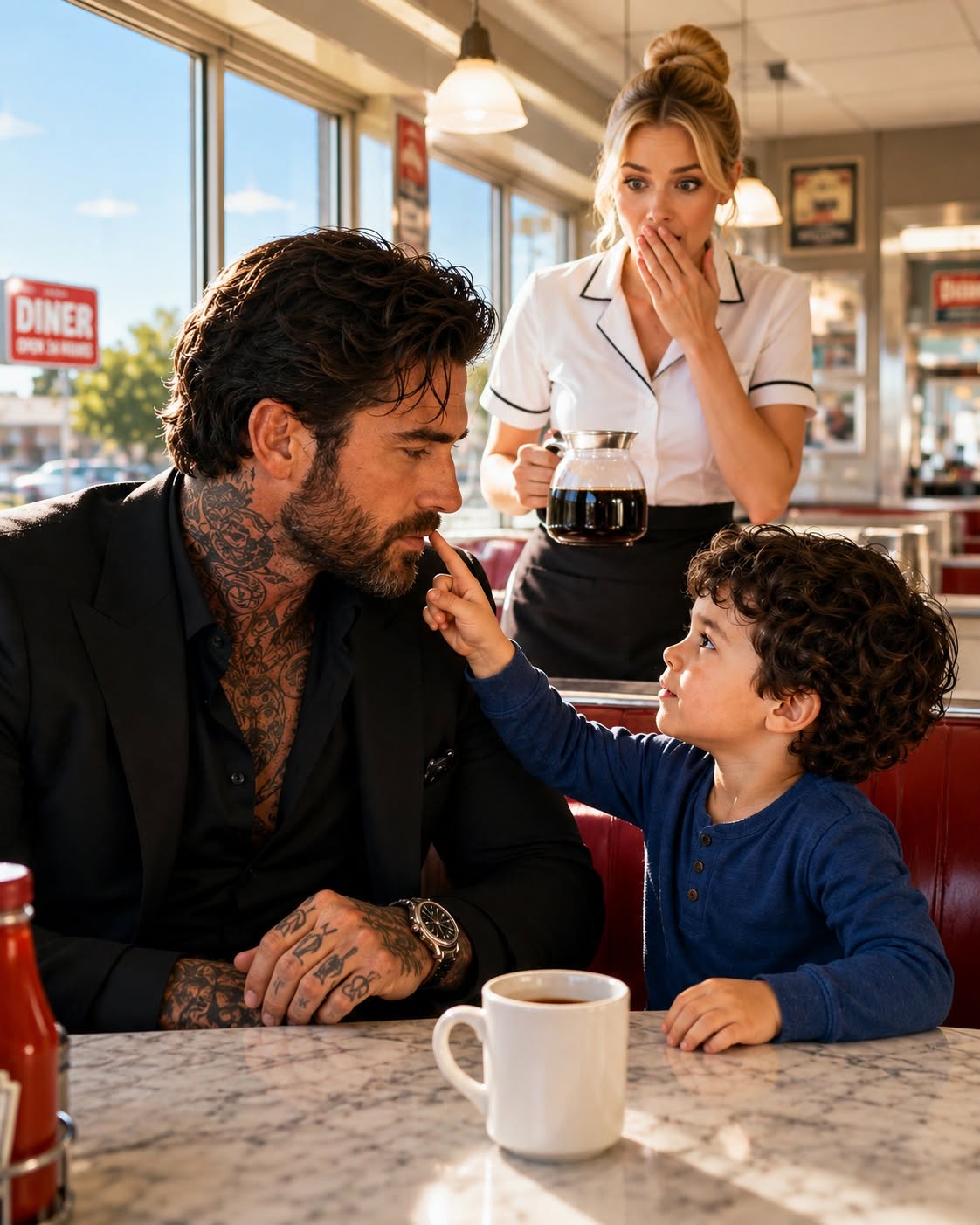
The mafia boss believed he could never have a child — until my five-year-old son looked up from a diner booth and asked him, “Sir, why are your eyes wearing my face?” The entire restaurant went silent. And when Matteo Vieri finally turned those same gray eyes toward me, the secret I had buried for six years came back to destroy the quiet life I had built.
I was carrying two plates of meatloaf and a bowl of chicken soup when Theo said it.
“Sir, why are your eyes wearing my face?”
Every sound in Rosie’s Diner seemed to stop at once. Forks froze over plates. The coffee machine hissed behind me. Rain tapped against the front windows like tiny warnings.
Theo was supposed to be coloring in the back booth beside the pie case, out of everyone’s way. My babysitter had canceled again, and Rosie had let me bring him because she had strict rules about almost everything except hungry children and scared women.
For six years, that had been my life. Cash tips. Cheap shoes. A fake last name. A small apartment with bad heating. A little boy with dark curls, serious gray eyes, and a heart too open for the world I had tried to hide him from.
“Theo,” I said quickly, forcing my waitress smile into place. “Baby, don’t bother the gentleman.”
Then I saw who he was talking to.
Booth seven. A black wool coat damp from the rain. Untouched coffee beneath one long hand. Dark hair loosened by the weather. A face made sharper by power, grief, and time.
Matteo Vieri.
My husband. The man I had run from six years ago.
For one terrible second, I forgot how to breathe.
Theo leaned closer, studying him with innocent curiosity. “You have my eyes,” my son said. “Did you borrow them?”
Matteo did not look at me first. He stared at Theo. At the curls. The mouth. The unmistakable gray eyes that had haunted one of the most dangerous men in New York for years.
Then, slowly, his gaze lifted to mine.
Recognition struck him first. Then disbelief. Then pain.
“Mara,” he said.
My real name.
Theo turned toward me, confused. “Mama,” he whispered, “he knows your other name.”
The diner listened. And Matteo Vieri stood. Not quickly. Not loudly. He didn’t need to. Some men enter rooms like weapons. Matteo entered like a storm, and everyone moved because storms do not ask permission.
I set the plates down with shaking hands and whispered, “Come with me.”
I led him through the kitchen and into the storage room, where shelves of flour, canned tomatoes, and paper towels suddenly felt like the only things keeping my past from swallowing me whole.
The door clicked shut.
For a moment, neither of us spoke. Matteo looked at me as if the last six years were standing between us with a knife.
Then his voice came low and controlled.
“Is he mine?”
My hand went cold against the shelf behind me. Outside, Theo laughed softly at something Rosie said, innocent and unaware that his entire life had just changed.
I looked at Matteo, at the man I had loved, feared, and fled.
And I knew one word could start a war.
“Yes,” I said. “He’s yours.”
The word left me before I could stop it, six years of silence collapsing into two syllables. Matteo went very still, the kind of stillness I remembered from before — the stillness that came right before he made a decision that couldn’t be undone.
“Six years,” he said. “You let me believe you were dead.”
“I let everyone believe that,” I said. “Including the people who were looking for a reason to make it true.”
His jaw tightened. “The Falcones.”
“They put a price on your head the week I found out I was pregnant. You told me yourself — anyone close to you was a target. I didn’t run from you, Matteo. I ran to keep him breathing.”
He turned toward the storage room door, toward the muffled sound of Theo’s laughter on the other side. “He has my mother’s chin.”
“He has your temper too,” I said. “God help me.”
Matteo almost smiled. Then it vanished, replaced by something harder. “You’re coming home. Both of you. Tonight.”
“I have a life here—”
“You have a diner apron and a fake last name,” he said. “That’s not a life, Mara. That’s hiding. And hiding stopped being an option the second he opened his mouth in front of forty strangers with cell phones.”
My stomach dropped. I hadn’t even thought of that — how many people in that diner had already pulled out their phones the moment Matteo Vieri stood up from booth seven.
As if summoned by the thought, his own phone buzzed once in his coat pocket. He glanced at it, and whatever color had returned to his face drained right back out.
“What is it?” I asked.
He turned the screen toward me. A single text, from a number I didn’t recognize.
Nice looking boy in that diner. Same eyes as you, Matteo. Word travels fast.
Matteo’s hand closed around the phone so tightly I heard the plastic case crack.
“Who is that number?” I asked.
“I don’t know yet.” He was already moving, pulling the storage room door open, scanning the kitchen, the dining room beyond it. “But I know who sends messages like that. Someone wanting me to know they’re watching before they ask for anything.”
“Matteo, there are children in that diner.”
“I’m aware.” He caught Rosie’s eye through the pass-through window and gave a small, controlled nod. She didn’t ask questions — just walked to the front door and quietly flipped the sign to CLOSED, ushering out the last two customers with an apology about a gas leak.
I grabbed Theo from the back booth, crayons still in his fist, and pulled him against my hip. He looked between us, sensing the shift in the air the way children always do.
“Mama, why is Rosie closing early?”
“Just a grown-up thing, baby,” I said, my voice steadier than I felt.
Matteo crouched to Theo’s height, gray eyes meeting gray eyes for the first time since the world had rearranged itself around booth seven.
“Hey,” Matteo said softly. “I’m Matteo.”
Theo studied him with the same unblinking curiosity he’d shown from the start. “You really do have my eyes.”
“I think you have mine,” Matteo said. “I’ve just had longer to figure out what to do with them.”
For a second, just a second, something in Matteo’s face broke open — the first unguarded thing I’d seen from him in six years.
Then his phone buzzed again.
You have one hour to bring both of them to the old Fulton warehouse. Come alone, or the boy learns who his father really is the hard way.
I read it over his shoulder and felt the floor tilt. “Matteo—”
“That’s not a real deadline,” he said, low, more to himself than to me. “That’s a test. Someone wants to see if I’ll panic.”
“Are you panicking?”
“No,” he said. “I’m deciding who dies tonight.”
“Don’t,” I said, grabbing his sleeve. “Not in front of him. Not ever, if you can help it. I didn’t hide him from that life for six years just to hand him back into the middle of it.”
Matteo looked at me — really looked, the way he used to before everything went wrong. “I’m not handing him into it. I’m ending the reason it exists.”
He made one call. Two words. “Bring Salvatore.”
Twenty minutes later, a black car pulled up outside Rosie’s, and a broad man in a gray suit stepped out, nodding once at Matteo before his eyes landed on Theo and stayed there a beat too long.
“That the boy?” Salvatore asked.
“That’s my son,” Matteo said, and the word landed like a door closing. “Who sent the text?”
“Unregistered number. But the warehouse — that’s Falcone territory. Someone wants you walking into a trap thinking you’re saving your family.”
“Then we don’t walk into it,” Matteo said. “We make them walk into us.”
What happened next took place far from Rosie’s front booth, in ways Theo never saw and never needed to. By morning, the number that had sent the threats no longer existed, and neither did the men behind it — a fact Matteo confirmed to me in four quiet words over coffee: “It’s handled. It’s over.”
I didn’t ask what “handled” meant. Some questions, I had learned a long time ago, were safer left closed.
What I did ask was harder.
“What happens to us now?”
Matteo set down his cup. “I’m not asking you to go back to hiding, Mara. And I’m not going to force you into a world you spent six years running from.” He looked toward the window, where Theo was pressing his palm against the glass, watching rain slide down in fat, lazy drops. “But I am asking you to let me be his father. Not from a distance. Not through a phone call once a year.”
“And if I say no to the rest of it? To you?”
“Then I’ll still show up every week,” he said. “I’ll still learn what cartoons he likes and what makes him afraid of thunder. That part isn’t negotiable. The rest — ” he exhaled, something almost vulnerable crossing his face for the second time that day — “the rest I’m hoping you’ll want too. Eventually. No warehouse timelines. No deadlines.”
I thought about six years of cash tips and cheap shoes and a name that wasn’t mine. I thought about the sound of Matteo’s voice saying he’s mine like it was the only sentence that had ever mattered to him.
“Eventually,” I said, “sounds like something I could try.”
He almost smiled — the real one this time, the one I remembered from before everything.
Theo turned from the window. “Is the rain scary thing over?”
“It’s over,” Matteo said, and reached out to ruffle his son’s dark curls for the first time in his life. “It’s over, kid.”
Rosie flipped the sign back to OPEN the next morning, same as always, and if any of her regulars noticed the black car that now idled outside once a week, waiting to pick up a boy with serious gray eyes for pancakes with his father, nobody in that diner ever said a word about it.
Have you ever had a secret from your past walk back into your life the moment you least expected it? I’d love to hear how you found the courage to face it.