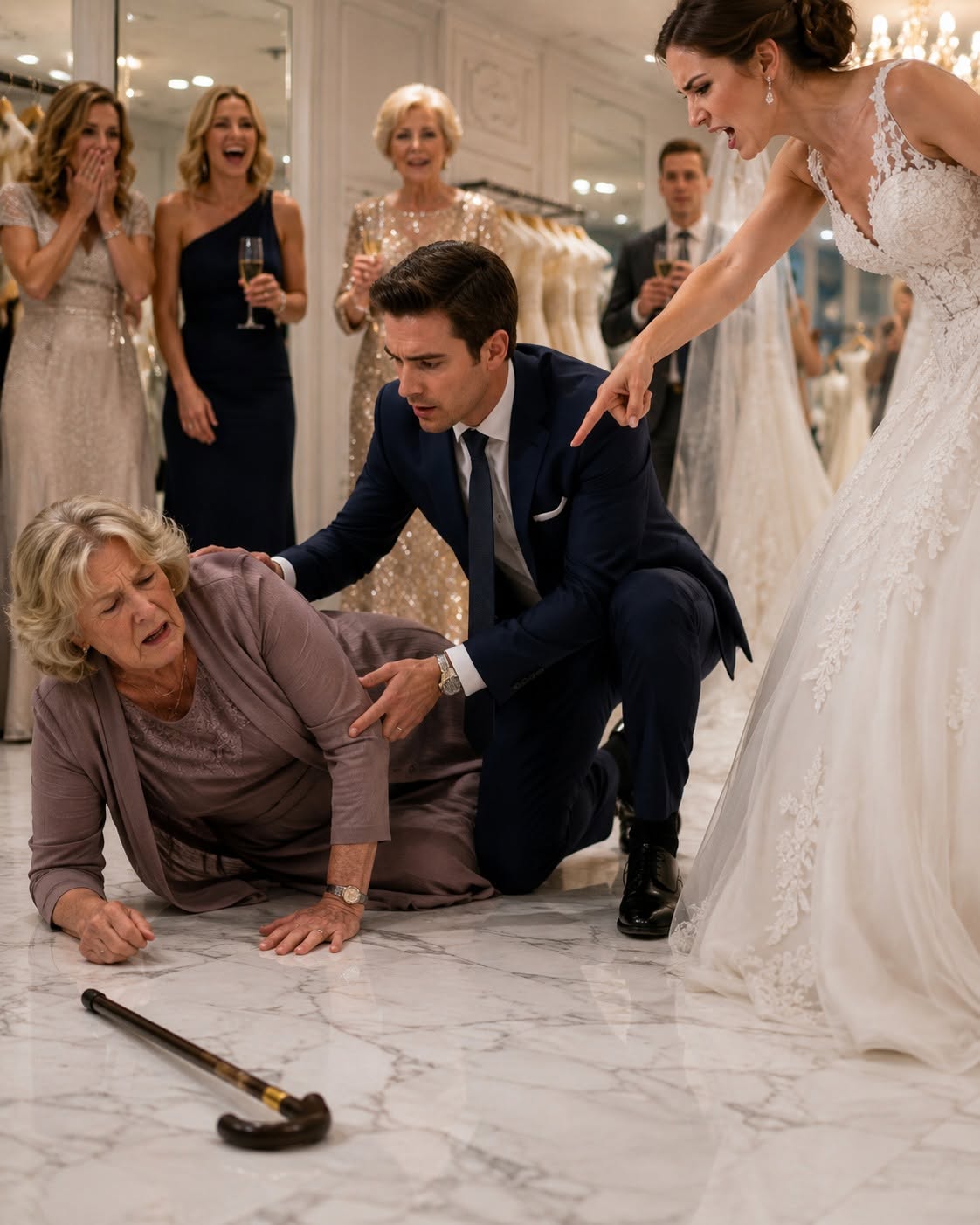
At my fiancée’s dress fitting, I watched her shove my elderly mother to the floor and snap, “Get up and hold my gown — you’re here to serve me.” My mother’s cane rolled across the room as everyone laughed. I helped her stand, then quietly smiled. On our wedding day, my bride reached the altar to find no groom, no guests, and a giant screen exposing her cruelty — while security escorted her from the venue I had already canceled.
The sound of my mother hitting the marble floor silenced me more completely than any scream could have.
Then my fiancée, Vanessa, looked down at her and said, “Get up and hold my gown — you’re here to serve me.”
My mother’s cane spun beneath a rack of silk dresses. For one frozen second, nobody moved. Then Vanessa’s sister covered her mouth and laughed. “Careful,” she said. “You’ll wrinkle the train.”
The bridal consultant stared at the floor. Vanessa’s mother, Celeste, lifted her champagne and smiled as though an old woman being humiliated was part of the entertainment.
I crossed the room, knelt beside my mother, and checked her wrist. Her name was Ruth. She was seventy-four, recovering from hip surgery, and had raised me alone after my father died. She had sold her wedding ring to pay my college tuition. She had never once asked me to repay her.
“I’m all right,” she whispered, though pain tightened her face.
Vanessa rolled her eyes. “Daniel, don’t ruin this over drama. She stepped on my hem.”
“I saw you push her.”
Celeste clicked her tongue. “A bride is under pressure. Your mother should understand boundaries.”
I helped Ruth stand and handed her the cane.
Vanessa expected shouting. Celeste expected an apology. Everyone in that room believed my silence meant surrender. They had mistaken discipline for weakness.
I smiled. “Of course. Let’s not ruin the wedding.”
Vanessa’s expression softened immediately. “That’s my reasonable man.” She kissed my cheek, leaving a faint mark of lipstick.
My mother looked at me with wounded disbelief, but I squeezed her hand twice, our old signal from childhood: Trust me.
What none of them knew was that the boutique belonged to a hospitality group I controlled through a holding company. The fitting room had security cameras, clearly disclosed at the entrance after previous thefts. The audio was clean. The footage was already backed up.
They also did not know that the cathedral venue, reception hall, limousine company, and luxury hotel rooms had been reserved through my corporate accounts. Vanessa told everyone my family was poor and that her parents were paying for everything. In reality, Celeste’s credit cards had been declined twice, and I had quietly covered every deposit.
On the drive home, Ruth stared through the window.
“You still plan to marry her?” she asked.
I looked at the bruise forming above her wrist.
“No,” I said. “But she still plans to have a wedding.”
That night, after settling her at home, I called three people: my attorney, the venue director, and the head of security. I gave them one instruction.
“Do nothing publicly yet. Let Vanessa believe every light is still turning on for her.”
The next morning, Vanessa called, breathless with excitement. “Daniel, the wedding planner says the final headcount is due Friday. Two hundred and forty guests. Can you believe it?”
“I can,” I said.
“And Mom wants to know if the ice sculptures are confirmed. The swan ones.”
“Already handled.”
She laughed, delighted, completely unaware. “You’ve been so calm about everything. I thought you’d still be upset about your mom.”
“I’m not upset,” I said. “I’m just focused on the wedding.”
That part was true.
Ruth came to sit with me that evening, her cane tapping softly against the kitchen tile. “You haven’t said a word about canceling anything,” she said. “Are you really going through with it?”
“I already told the venue director something,” I said. “He asked if I was sure.”
“What did you tell him?”
“That I’ve never been more sure of anything.”
She studied my face for a long moment, the way she used to when I was a boy hiding a bad report card. “Daniel. What exactly did you tell that man to do?”
My phone buzzed before I could answer. A text from the venue director: Cathedral booking pulled. Reception hall released. Should I notify the caterer, or are you doing that yourself?
I looked up at my mother.
“You’ll want to be there,” I said. “Front row. If you’re feeling strong enough to stand.”
The days leading up to the wedding moved like nothing was wrong. Vanessa sent Ruth a photo of the ice swans, captioned hope your hip is better in time to watch me marry your son! Ruth didn’t answer it. I told Vanessa my mother was resting and would see her at the ceremony. That much, at least, was true.
Celeste called twice about the guest seating chart. I approved every request. I let her believe her cousin from Houston would have a seat near the front, that the string quartet would play her favorite song, that everything she had planned would happen exactly the way she wanted it.
None of it would.
Three days before the wedding, my attorney sat across from me with the security footage pulled up on his laptop. Clean audio. Clear angle. Ruth on the floor, her cane spinning, Vanessa’s voice unmistakable: Get up and hold my gown — you’re here to serve me.
“You could sue for the assault alone,” he said. “But you want the video shown, not filed.”
“I want everyone in that room to see exactly who they were standing next to,” I said.
“And the venue?”
“Already canceled. Officially, this morning. The cathedral thinks there was a scheduling conflict. The reception hall thinks I found a better offer. Nobody outside this room knows the real reason yet.”
“What about the guests?”
“I’m sending a new invitation,” I said. “Same date. Different venue. Smaller.”
He raised an eyebrow. “Does Vanessa know about the new venue?”
“No,” I said. “Vanessa doesn’t know there is one.”
On the morning of the wedding, Vanessa’s makeup artist arrived at seven. Her hair was pinned by eight. By nine, she stood in her dress in front of the mirror at her parents’ house, glowing, completely certain that two hundred and forty guests were already taking their seats at the cathedral.
She arrived at eleven, exactly on time, in a white car trimmed with flowers she had chosen herself.
The cathedral doors were locked.
No valet. No guests. No flowers on the steps. Just a single black car parked at the curb, and a small crew setting up a portable screen on the empty front lawn.
I watched from that car as she climbed out in her gown, confusion sliding into panic as she looked up and down the empty street.
“Daniel?” she called out, spinning toward the church doors. “Where is everyone? Daniel, is this some kind of joke?”
I stepped out.
“There’s no ceremony here today,” I said.
“What are you talking about? The invitations said—”
“The invitations went to a different address,” I said. “Everyone who matters is already there.”
Her face went white. “You changed the venue? Without telling me?”
“I changed a lot of things without telling you,” I said. “Just like you never told me why my mother had a bruise on her wrist the week of our engagement party. Or the week after.”
Celeste came rushing up the steps behind her, heels clacking, phone pressed to her ear. “The florist says there’s no delivery address on file. Vanessa, what is happening—”
“Ask your daughter,” I said.
That’s when the screen behind them lit up.
The footage played clean and clear across the cathedral lawn — Ruth on the marble floor, the cane rolling away, Vanessa’s voice cutting through the silence: Get up and hold my gown — you’re here to serve me. Celeste’s laughter. The sister’s joke about wrinkling the train.
Vanessa spun toward the screen, her hands flying to her mouth. “Turn that off. Turn it off right now.”
“It’s already been sent,” I said. “To your two hundred and forty guests. To the venue you told everyone my family couldn’t afford. To your father, who I understand didn’t know about the declined cards.”
Celeste’s phone slipped from her hand.
Security, the same two men who had quietly watched from the black car, stepped forward. “Ma’am, this property has been reserved for a private filming. I’ll need you to come with me.”
“This is my wedding,” Vanessa said, her voice cracking. “Daniel, please. We can fix this. I’ll apologize to your mother, I’ll do whatever you want—”
“You had that chance in the fitting room,” I said. “You chose to laugh instead.”
I turned and walked back to the car. In the back seat, dressed in soft blue, sat Ruth, watching through the window with her cane resting against her knee.
“Was that everything you needed to see?” I asked her.
“I didn’t need to see any of it,” she said quietly. “I already knew who she was the moment she pushed me. I just didn’t know my son had this much patience in him.”
“I learned it from you,” I said.
We drove to a small garden two towns over, where thirty people who actually loved us were already waiting — Ruth’s sister, my old college roommate, two neighbors who used to bring her soup after her surgery. No swans. No string quartet. Just folding chairs, real flowers, and a version of the day that had nothing left to prove.
I knelt beside Ruth’s chair before anyone else arrived and squeezed her hand twice.
Trust me, it used to mean.
This time, it just meant: we’re safe now.
Have you ever had to let someone show you exactly who they were — and finally believe it? I’d love to hear how you found the strength to walk away.