I called my son from our kitchen in Detroit to tell him his mother had died.
He let out a tired sigh and said, “Dad, please don’t turn this into something bigger than it has to be. I’m leaving for Europe with my wife. The tickets can’t be refunded.”
So I buried Diane in a small chapel with only five people sitting in the pews.
Ten days later, his wife walked into my living room carrying a designer handbag, completely unaware of what Diane had left behind.
The phone rang twice before Darnell answered. His voice was distant and annoyed, like I had interrupted something far more important than the death of his own mother. In the background, I could hear music, laughter, and glasses touching together. Maybe he was at a restaurant. Maybe some rooftop place in Chicago where people take pictures under city lights and call it happiness.
I stood alone in our kitchen in Detroit, one hand braced against the counter. Diane had been gone less than a day. Her coffee mug still sat beside the sink, the one with the faded blue rim and the tiny crack near the handle. Her reading glasses were still near the window. Her chair was still pulled slightly away from the table, as if she had only stepped into the next room.
But she had not.
I told my son his mother was gone. For a moment, there was silence. Then he sighed.
“Dad, come on. Don’t make such a big deal out of it.”
I stared at the kitchen wall, trying to understand how those words had come from my child.
“Darnell,” I said slowly, “your mother died this morning.”
Another pause. Then his voice sharpened with impatience.
“I’m sorry, Dad, but what exactly do you expect me to do? We’re leaving in a few days. Mom would understand. The tickets are non-refundable.”
Mom would understand. People always say the dead would understand when what they really mean is that they do not want their plans disturbed.
He ended the call first.
I stood there holding the phone while a garbage truck rattled down the street and someone across Fielding Street kept cutting their grass, as if the world had not just ended inside my house.
That afternoon, I made the calls. The funeral home. Mrs. Pette next door, who always knew when to bring food and when to bring quiet. The church on Harper Avenue, where Diane had once volunteered during holiday food drives. Every conversation felt too normal for the words I had to say.
By Thursday, I buried my wife. There were only five people in the chapel. Mrs. Pette and her husband came. Diane’s old friend Beverly came, wearing the same lavender perfume she had worn to our wedding years ago. Deshawn, our mail carrier, stopped by after finishing his route, still in uniform, because Diane used to leave cold water on the porch for him in July and coffee inside the storm door in January. The fifth person was Harold Whitfield, our estate attorney. He had been calling Diane’s phone often during the weeks before she passed. At the time, I did not know why.
Darnell was not there. Neither was his wife.
I stood at the front of that little chapel and looked out at the empty rows. Diane had spent her whole life holding other people together. She made lunches, remembered birthdays, paid every bill on time, and baked Thanksgiving pies in the same dented pan she had owned before we were married. She never asked to be praised. At the end, all she wanted was her son. And he chose Europe.
I did not say that during the eulogy. Some truths are too painful to place in front of strangers.
Ten days passed. Darnell did not call. His wife did not call. Every morning, I woke expecting to hear Diane in the kitchen: a cabinet door opening, a spoon scraping inside the coffee tin, that soft little cough she always made before saying my name. Every morning, I remembered the house belonged to me now in the loneliest way possible.
Then, on the tenth day, the front door opened. Heels clicked across the hardwood floor. A bright voice floated through the hallway like nothing terrible had happened.
“Hello? Raymond?”
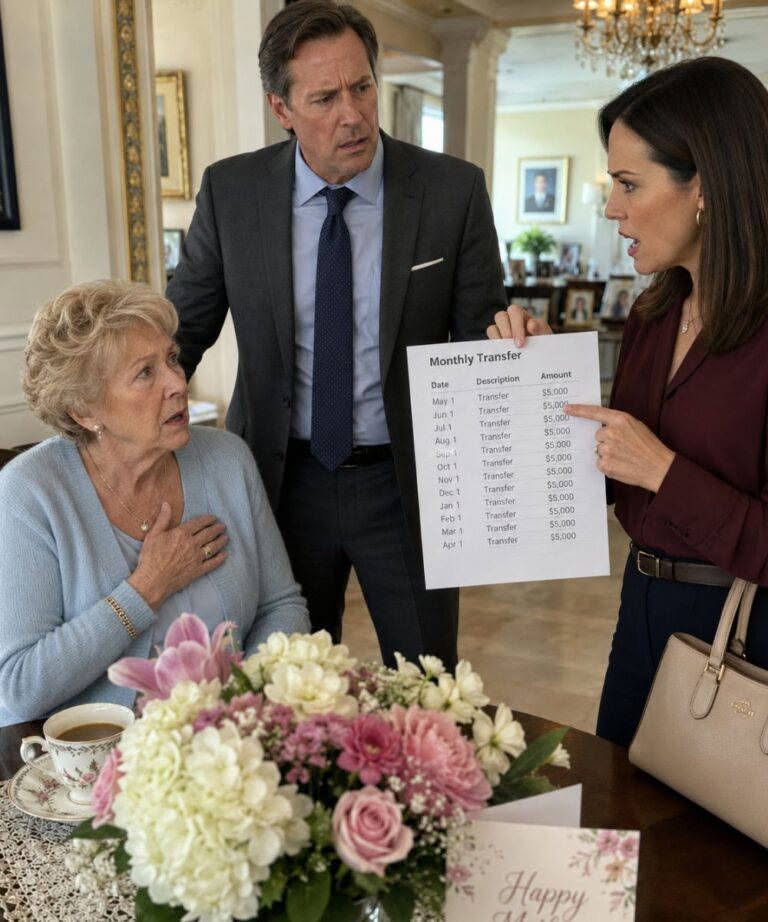
Darnell’s wife stepped into my living room wearing expensive clothes, perfume too strong for a grieving house, and a designer handbag tucked under her arm. She smiled at me. Not with sympathy. With expectation.
And on the coffee table between us sat a sealed folder from Harold Whitfield, signed by Diane three days before she died.
That was the moment I finally understood why my wife had been calling the attorney.
—
Darnell’s wife set her handbag on the arm of the couch and reached for the folder before I could stop her.
“What’s this?” she asked, already smiling like she expected good news.
“It’s from Harold Whitfield,” I said. “Diane’s attorney.”
Her smile faltered for just a second. “Why would Diane need a folder from an attorney?”
“You’d have to ask her,” I said. “She’s not here to answer.”
She opened it anyway. Inside was a single typed letter, and beneath it, a stack of bank statements clipped together with a yellow sticky note in Diane’s handwriting.
Her face changed as she read.
“This says the house account was moved,” she said slowly. “Into a trust. Three days before she—” She stopped herself.
“Before she died,” I said. “Yes.”
“A trust for who?”
I hadn’t opened the letter myself yet. I’d been waiting, almost afraid of what Diane had decided without telling me.
“Read the second page,” I said.
Her hands were shaking now. She turned the page, scanned it, and went very still.
“This can’t be right,” she whispered. “Darnell’s name isn’t on here at all.”
Behind her, my phone buzzed on the counter. A text from Harold Whitfield: Raymond — did she see it yet? Call me when you can. There’s more you need to know before Darnell does.
Darnell’s wife — Vanessa — snapped the folder shut like she could undo what she’d already read.
“This is a mistake,” she said. “Diane wasn’t in her right mind. She was sick. People make bad decisions when they’re scared.”
“She was sick,” I said. “She wasn’t confused. She sat in Harold’s office and signed every page herself.”
“Then we’ll contest it.” Vanessa’s voice had gone hard, all the brightness drained out of it. “Darnell is her only son. No court in Michigan is going to let a stranger take what belongs to him.”
“Read who it belongs to,” I said. “Before you threaten a lawsuit over it.”
She read the third page. Her face went white.
“Deshawn Carter,” she said. “Your mailman? Diane left the house account to your mailman’s kids?”
“A trust for their college,” I said. “Started two years ago. She never told me either — not until Harold called last week.”
“That’s insane. That money should go to family.”
“She tried calling family,” I said. “For months.”
I picked up my phone and turned it around so she could see the call log Harold had sent over that morning — the one he’d been holding onto, waiting for the right moment. Eleven missed calls from Diane to Darnell in her final two months. Not one returned.
“She had a diagnosis in March,” I said. “Stage four. She didn’t want to worry him until she knew more. By the time she was ready to tell him, he wasn’t picking up.”
Vanessa’s mouth opened, then closed.
“You knew,” I said. “Didn’t you. That’s why you came today. Not for me. For the folder.”
“Darnell doesn’t check his phone when we’re traveling,” she said, too fast. “That’s not—”
“Eleven calls, Vanessa. Over two months. You’re telling me he never once looked down and saw his mother’s name?”
She didn’t answer that. She picked her handbag back up off the couch arm, and for a second I thought she’d just leave, the way Darnell always did when a conversation got too heavy to carry.
Instead she said, “I’ll get our lawyer to look at this trust. Diane clearly wasn’t stable enough to—”
“Harold already told me you’d say that.” I reached into my jacket and set one more paper on the table — a psychiatric competency evaluation, dated the same day as the signing, requested by Diane herself. “She knew you’d try. She planned for it.”
Vanessa stared at the paper a long moment. Then, quietly, almost to herself: “She never even liked me.”
“She liked you fine,” I said. “She just knew what you’d do the day she was gone. She wasn’t wrong.”
My phone rang. Harold Whitfield, right on time.
“Raymond,” he said, when I picked up. “Is she still there?”
“She’s here.”
“Good. Tell her the trust was filed and finalized eight days before Diane passed. It’s not contestable — I made sure of that personally, at her request. And tell Darnell, when he lands, that his mother left him something too. Not money. A letter. I think he should read it alone.”
I looked at Vanessa. Her expensive coat, her designer bag, the folder still trembling slightly in her hand.
“There’s a letter,” I said. “For Darnell. Just him.”
She didn’t ask what was in it. Maybe some part of her already knew she wasn’t going to like it.
Darnell flew back three days later — not for me, Harold told me later, but because the family attorney had made it clear the estate wouldn’t move forward without his signature on the release paperwork. He came to the house alone. Vanessa stayed in the car.
He looked older than I remembered. Or maybe I just hadn’t looked at him closely in a long time.
“Dad,” he said, standing in the doorway where his mother used to stand. “I heard about the trust.”
“I figured you would.”
“I’m not here about the money.”
“I know,” I said. “Harold told you about the letter.”
He nodded, and I saw something in his face I hadn’t seen since he was young — not annoyance, not impatience. Something closer to fear.
I handed him the envelope. His name in Diane’s handwriting on the front, the same handwriting from every birthday card and grocery list she’d ever left on that counter.
“Do you want me to leave the room?” I asked.
“No,” he said. “Stay.”
He opened it standing up, right there in the kitchen where I’d told him she was gone. I watched his eyes move down the page, watched his jaw tighten, watched him read it twice.
He didn’t tell me what it said. He still hasn’t, not fully. But when he finished, he folded the letter carefully, the way you’d fold something you intended to keep for a long time, and he sat down at the kitchen table — in his mother’s chair, the one still pulled slightly away — and put his head in his hands.
I made two cups of coffee. I set one in front of him without a word.
He didn’t drink it right away. But he didn’t leave, either.
That was three months ago. Vanessa and Darnell aren’t together anymore — I don’t know all of it, and I didn’t ask. What I do know is that Darnell comes by most Sundays now, and last month he sat with Deshawn on the porch for almost an hour, asking about his kids, about the college trust, about a mother he says he’s still learning how to grieve properly.
I still keep Diane’s mug by the sink. I never washed the coffee ring out of the bottom. Some mornings I make coffee for two, out of habit, and pour the second cup out slowly, watching it go down the drain, and it doesn’t hurt the way it used to. It just feels like keeping her company a little longer.
Have you ever found out, too late, what someone you loved was quietly carrying alone? I’d like to hear how you made peace with it.