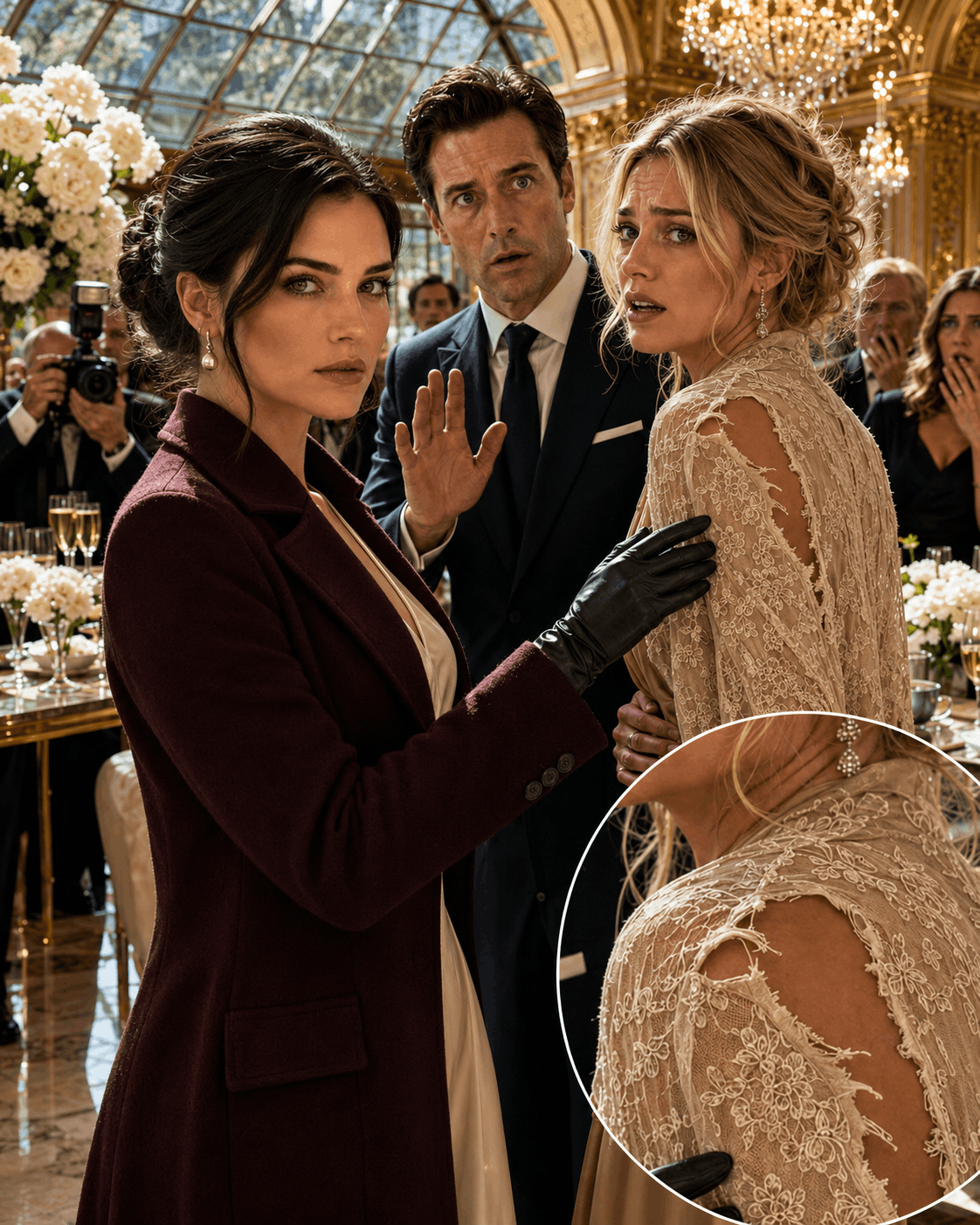
His mistress wore the lace bolero from my wedding dress to her engagement brunch. My husband stood beside her like I was the embarrassing part of the room. His mother said old things should live again, and everyone expected me to cry, leave, or make myself small. What they did not know was that the lace was not just lace, and the room they laughed in was already turning against them.
I stepped into the Palm Court at the Plaza wearing a black coat, pearl earrings, and no invitation. The string quartet was playing softly under the glass ceiling. White flowers covered every table like the whole room had been dressed for a wedding. Except this was not mine.
Sloane Whitaker stood in the center of it all with one hand on her pregnant stomach. She wore a champagne silk gown, bright lipstick, and my grandmother’s lace across her shoulders. It was the same lace I wore when I married Preston Hayes six years earlier. The same lace that had been sealed with my wedding dress in the cedar room at Rosemere.
Preston saw me first, and his smile died for half a second. Then he crossed the room with that calm rich-man face he used when he wanted everyone else to feel unreasonable. “Avery,” he said softly, “try not to make a scene.”
I looked past him at the lace. Sloane touched the little clasp at her throat and smiled. “I hope you don’t mind,” she said, like she had borrowed earrings from a friend. Her voice was soft, but her eyes were smug. She wanted the room to see that she had taken more than my husband.
Then Marjorie Hayes rose from the head table. Preston’s mother wore ivory tweed and pearls, like cruelty needed a dress code. “It looks better with her modern gown,” she said loudly. Then she added, “Old things should live again.”
I did not yell. I did not lunge. I walked closer until I could see the seam under Sloane’s right shoulder. Someone had cut the bolero from my preserved wedding dress with scissors, and they had done it badly.
For a moment, I was back in that cedar room two days earlier. I remembered opening the archival box and seeing my gown lying there with its shoulders bare. I remembered touching the torn fabric and realizing someone had not borrowed my past. They had cut it out.
Preston stepped between us. “Walk away, Avery,” he said. He sounded bored, like my pain was interrupting his brunch. That was his mistake. He still thought I had come as his wife.
I looked at him and then at Sloane. The photographers were still near the dessert table. Half the room had their phones hidden in their laps. Everyone wanted to watch me break politely.
I removed my gloves finger by finger. The room went quiet. Marjorie lifted her chin, waiting for tears. Sloane smiled wider.
“Take it off,” I said.
Sloane blinked. Preston’s jaw tightened. Marjorie said, “You will not humiliate a pregnant woman in public.”
I turned to her and said, “You humiliated a wife in public.”
That was when Preston noticed my phone. His eyes dropped to the screen, then back to my face. I checked the time. 10:03 a.m.
“What are you doing?” he asked.
“Watching,” I said.
“For what?”
I glanced toward the entrance. Two men in dark suits walked into the Palm Court. Behind them came my attorney, Helena Price, holding a leather folder. Preston’s face changed before she said a word.
Helena stopped beside me and opened the folder. Detective Maria Calder walked in right behind her with a badge at her belt. The room froze. Sloane’s hand slid from her stomach to the stolen lace. Preston stared at me.
“You brought a lawyer to brunch?” he asked.
I touched the torn seam one last time. Then I looked at his mistress, his mother, and the stolen lace on her shoulders.
“No,” I said. “I brought three.”
The room did not move.
Preston’s eyes went from Helena to Detective Calder, then back to me. For the first time in six years, I watched him calculate and come up empty.
“This is a private event,” he said. His voice was still controlled, but his hands were not. He had pressed one flat against the table.
Helena opened the folder without looking at him. “Mr. Hayes, you’ve been served.” She placed the documents on the white linen like she was setting a place for dinner.
Sloane made a small sound. Not words. Just air leaving her body.
Marjorie stepped forward. “Preston, call Gerald right now.”
“Gerald is already aware,” Helena said pleasantly.
That was when Sloane turned to Preston. Not to me. To him. And the look on her face was not the smug smile from five minutes ago. It was something colder. Something that asked a question she had not expected to need answered.
“What is she serving you?” Sloane asked.
Preston did not answer her.
“Preston.” Her voice sharpened. “What is in that folder?”
He straightened his jacket. That small, practiced move he always made when he needed a second to think. I had watched him do it in boardrooms for years. I knew what it meant.
He did not know everything that was in that folder either.
Detective Calder stepped beside Helena. “Ms. Whitaker,” she said, “we’ll need a few minutes of your time as well.”
Sloane’s hand went back to her stomach. “I don’t understand—”
“The lace,” I said quietly. “It was cut from a sealed preservation box. That’s destruction of documented marital property.” I paused. “But that’s the smaller charge.”
The color left Sloane’s face.
Preston looked at me then. Really looked at me. Like he was seeing something he had miscalculated badly.
“Avery,” he said. “Whatever you think you know—”
Helena touched my arm once. A signal.
I picked up my gloves from the table. One photographer near the dessert station had stopped pretending to look away.
Then my phone buzzed. I read the message. And for the first time that morning, I felt something close to relief.
Except when I looked up, Marjorie was already on her phone in the corner. And the person she was calling was not Gerald.
…
Helena’s hand closed around my wrist before I could cross the room.
“Let Marjorie make that call,” she said.
“You know who she’s calling?”
“I’m counting on it.” Helena closed the folder and nodded toward Detective Calder. “Give her three minutes.”
I watched Marjorie in the corner. Her back was turned, one hand pressed flat against the wall like she needed it to hold her up. Her voice was low and fast and she was nodding at whatever the other person said.
Sloane had not moved. She was still standing in the center of the room with the stolen lace across her shoulders and the color gone from her face. The photographers had stopped pretending. Half the engagement brunch was now an audience.
Preston came to my left. Close enough that I could smell his cologne. The same one he had worn the morning he told me the marriage had simply run its course.
“You’re making a mistake,” he said quietly.
“You cut my grandmother’s lace off a preserved wedding dress,” I said. “Which part of this is my mistake?”
“I didn’t touch your dress.”
I turned to look at him. “I know.”
Something shifted in his face.
“Then what is this really about?” he asked.
“The accounts, Preston.”
His jaw tightened.
“The Cayman account you opened four months before you asked for the divorce,” I said. “The one Gerald helped you structure. The one that received eleven transfers from our joint assets while you were telling me we needed to simplify our finances.”
He said nothing.
“Helena has the wire records,” I said. “Detective Calder has a forensic accountant on her team. And the folder you were just served with is a civil filing, not a criminal one.” I paused. “The criminal referral went to the DA’s office yesterday morning.”
Preston looked at the folder on the table. Then at Helena. Then back at me.
“You’ve been building this for how long?” he asked.
“Since the morning I opened that cedar box and found my dress with its shoulders bare,” I said. “Someone who could walk into Rosemere without triggering the alarm system. Someone who knew the cedar room code. Someone who had been in that house as recently as three weeks ago.” I looked at him. “The security log doesn’t lie, Preston.”
His mouth opened. Then closed.
Across the room, Marjorie ended her call. She turned and her eyes found mine. Not Preston’s. Mine. And I understood then that whatever she had just been told, it had not gone the way she expected.
She walked toward us slowly. The ivory tweed. The pearls. The chin still lifted.
“You should know,” she said, stopping in front of me, “that you are embarrassing yourself.”
“Marjorie,” Helena said pleasantly, “you just called Warren Tillis.”
The chin stayed up. But something behind her eyes moved.
“Warren Tillis is currently being interviewed by Detective Calder’s colleague in the lobby,” Helena continued. “He arrived twenty minutes ago. We asked him to wait.”
Warren Tillis was Marjorie’s personal attorney. He had also notarized three of the eleven asset transfers.
Marjorie said, “That is not possible.”
“He came voluntarily,” Helena said. “He’s been cooperative for about two weeks now.”
Preston turned to his mother. “You used Tillis for the transfers?”
Marjorie said nothing.
“Mother.” His voice dropped. “Tell me you did not use Tillis.”
“I was protecting you,” she said.
“From what?”
“From her.” Marjorie pointed at me without looking at me. “She was never right for this family. She was always going to take what she could and—”
“She built half of what I have,” Preston said. Something I had never heard before was in his voice. Not guilt. Closer to the specific exhaustion of a man who has just understood the full cost of a decision he cannot undo. “The Meridian deal. The Hargrove restructure. That was her work.”
Marjorie said, “The family name—”
“Stop.” He said it once and she stopped.
The room was very quiet. The string quartet had not played in several minutes.
Sloane spoke from the center of the room. “Can someone please tell me what is happening?”
Everyone looked at her.
She was still holding the clasp at her throat. The champagne silk. The stolen lace. She looked younger suddenly. Less like someone who had won something and more like someone who had walked into a building without checking what it was.
“The lace,” I said, and I crossed the room toward her. Not fast. There was no need to move fast anymore.
I stopped in front of her. This close, I could see the rough edge where the scissors had gone through the original seam. Whoever had done it had been careless or in a hurry. Probably both.
“I’m not angry at you,” I said. And I meant it. I had been, early on, but that had burned down to something quieter over the months. “You didn’t know what you were taking when you put it on.”
Sloane looked at me carefully. “What do you mean?”
“My grandmother brought that lace from Galway in 1951,” I said. “She wore it at her wedding. My mother wore it at hers. I wore it at mine. It was the only thing in that cedar room I would not have been able to replace.” I reached up and unclipped the clasp at her throat. She let me. “It’s not a prop. It’s not a statement. It’s just something that belongs to the women in my family.”
I held the bolero in both hands. The lace was intact. Whoever had cut it had taken the whole piece cleanly enough that it had not been damaged. That was the one thing that had gone right.
Sloane said, quietly, “I didn’t know it was preserved. He told me it was just stored.”
I looked at her. “Did he tell you about the accounts?”
A long pause.
“No,” she said.
I nodded once. Then I walked back to Helena.
Detective Calder returned from the lobby eleven minutes later. She stopped beside Helena and said something low that I did not catch. Helena’s expression did not change, but she turned one page in the folder.
“Mr. Hayes,” Helena said, “Tillis has confirmed his role in the notarizations. He’s provided documentation of the instruction chain.” She looked at Preston. “The instructions came from this address.” She set a single page on the table.
Preston looked at it. Then he looked at his mother.
Marjorie had gone very still.
“You signed the instruction letters,” Preston said. Not a question.
“I was acting on your behalf—”
“I never asked you to move the accounts,” he said. “I asked you to talk to Tillis about the estate structure. That was all.”
“You needed to be protected—”
“From my own wife.” The exhaustion in his voice had become something else. “You structured eleven transfers without telling me. You used my power of attorney—”
“It was still valid—”
“It was valid for the property sale in March,” he said. “Not for this.”
Marjorie said nothing.
Preston picked up the page. He read it twice. Then he set it back down and did not touch it again.
“Gerald is going to tell you there is a defense,” he said finally. “There isn’t. Not if Tillis has already given them the chain.” He turned to Helena. “What does she want?”
Helena looked at me.
I had thought about this moment for eight months. I had rehearsed it in the car, in the early mornings, in the cedar room with the empty archival box on the floor beside me. I had imagined saying something that would land like a door closing.
But standing there in the Palm Court with the white flowers and the quiet string quartet and the lace folded in my hands, I found I did not want a line.
I wanted it to be over.
“Full restitution of the transferred assets,” I said. “The Rosemere deed returned to my name alone. His signature off the Meridian licensing rights, which were mine before the marriage. And a formal acknowledgment, in writing, of his role in the asset transfers — not his mother’s role. His.”
Preston said, “And if I agree to that?”
“Then Helena files the civil agreement and the DA’s office is informed that full cooperation has been given,” I said. “What they do with that is not my decision.”
He was quiet for a long moment.
Sloane had moved to a chair near the window. She was sitting with her hands in her lap, looking out at Fifth Avenue. She did not look like someone who had won an engagement brunch. She looked like someone who was doing arithmetic and not liking the sum.
“All right,” Preston said.
Marjorie said, “Preston—”
“Mother.” He did not raise his voice. “Sit down.”
She sat.
Helena and I left the Palm Court at 11:40 a.m.
The white flowers were still on every table. The glass ceiling was still full of light. Two of the photographers were outside on the steps and they moved toward us, but Helena stepped in front smoothly and said something brief that made them stop.
We stood on the sidewalk on Central Park South. The late morning was cold and clean.
“Tillis really came voluntarily?” I asked.
“He called us,” Helena said. “Three weeks ago. He did not enjoy being the last person holding documentation that named him as the notary on eleven questionable transfers.”
“And Marjorie?”
Helena was quiet for a moment. “The DA’s office will decide what to do with the instruction letters. That’s not a small thing, Avery. Using a power of attorney outside its defined scope, on that scale, for that amount — that carries consequences.”
I looked up at the Plaza. Somewhere inside, Preston was still standing at a white-flowered table with a leather folder in front of him.
“He didn’t know,” I said. Not defending him. Just saying what was true.
“No,” Helena agreed. “He didn’t know all of it. That won’t help him as much as he hopes, but it’s true.”
I held the lace bolero in both hands. In the daylight, I could see where the scissors had gone through. The cut was rough at one edge but the lace itself was unbroken. My grandmother’s hands had made this. In a room I would never see, in a country I had only visited once, she had made something that had lasted long enough to travel across three weddings and one very bad engagement brunch.
I folded it carefully and put it in my coat pocket.
Helena said, “Are you all right?”
I thought about the cedar room. The empty archival box. The eight months of bank records and security logs and calls with forensic accountants at seven in the morning. I thought about the night I sat on the floor of the Rosemere kitchen and understood that the man I had married had not left me for another woman. He had been restructuring the exit for two years before he told me.
“I will be,” I said.
Helena nodded like that was the right answer. She flagged a cab and got in.
I stood on the sidewalk for another minute.
Then I walked to the corner, turned south, and did not look back at the Plaza once. There was nothing behind me I needed to see.
That night I made dinner for one, poured one glass of wine, and set the bolero on the kitchen table under the lamp. I had a number for a textile conservator in the West Village who specialized in antique lace. I would call her in the morning.
My grandmother had brought this across an ocean. My mother had worn it on the happiest day of her life. I had worn it on a day that turned out to be something else entirely.
It had survived all of that.
So had I.
Sometimes the things people try to take from us are the very things that remind us who we are. Have you ever had someone underestimate how prepared you were? Share your story in the comments — I’d love to hear it.